How to Measure Customer Satisfaction: Metrics, KPIs, Examples
Customer satisfaction is not one number. A customer may be happy with one support reply but unsure about renewing. Another may like the product but struggle with onboarding. That is why one rating rarely tells the full story.
A good measurement process usually combines a few signals: a direct satisfaction score, an effort score, a loyalty question, written feedback, complaints, reviews, and retention data. Together, those signals help you understand what customers think, where the experience breaks down, and what your team should fix first.
This guide explains how to measure customer satisfaction, which metrics to use, when to use them, what questions to ask, and how to turn the results into useful improvements.
What is customer satisfaction?
Customer satisfaction measures how well a product, service, or experience meets customer expectations.
Those expectations can come from many places: your website, pricing page, sales process, onboarding, product quality, delivery, support, or previous interactions with your team. That is why satisfaction is easier to measure when you define the exact experience you are asking about.
A useful customer satisfaction survey usually focuses on one of three levels:
| Level | What it measures | Example |
|---|---|---|
| A specific interaction | How one moment went | A support ticket, purchase, delivery, appointment, onboarding step, or service visit |
| The overall relationship | How the customer feels about your company over time | A quarterly NPS survey, account review, or customer experience survey |
| Future risk | Whether the customer is likely to stay, renew, reorder, or leave | A retention survey before renewal or a cancellation survey after churn |
This distinction matters. A customer may be satisfied with one support reply but still unsure about renewing. Another may like the product but struggle with onboarding. Clear scope helps you avoid vague ratings and confusing data.
A good customer satisfaction measurement process should answer four questions:
- What did the customer experience?
- How satisfied were they?
- Why did they give that answer?
- What should happen next?
The score gives you the signal. The follow-up answer explains what caused it. The trend shows whether the experience is improving or getting worse.
How to measure customer satisfaction
The best way to measure customer satisfaction is to match the method to the customer moment. A support ticket, checkout flow, renewal conversation, public review, and cancellation all tell you something different.
Most teams use a mix of:
- CSAT to measure satisfaction with a specific experience
- NPS to measure loyalty and likelihood to recommend
- CES to measure effort and friction
- Customer feedback surveys to understand the reason behind the score
- Reviews and complaints to find recurring issues customers mention in their own words
- Behavioral signals from your product or service usage patterns (retention, churn, referral rate, usage engagement, repeat purchase rate, etc.)
1. Customer Satisfaction Score (CSAT)
Customer Satisfaction Score, usually called CSAT, measures satisfaction with a specific experience. It works well after support tickets, purchases, deliveries, appointments, onboarding steps, service visits, events, or project milestones.
A common CSAT question is: “How satisfied were you with your experience?”
Most CSAT surveys use a 1 to 5 scale, from very dissatisfied to very satisfied. Many teams count the top two answers as satisfied responses.
Formula: CSAT = satisfied responses / total responses x 100
If 100 customers respond and 78 choose a satisfied answer, your CSAT score is 78%. It’s a good idea to add one follow-up question so the score has context: “What is the main reason for your rating?” or “What could we have done better?”
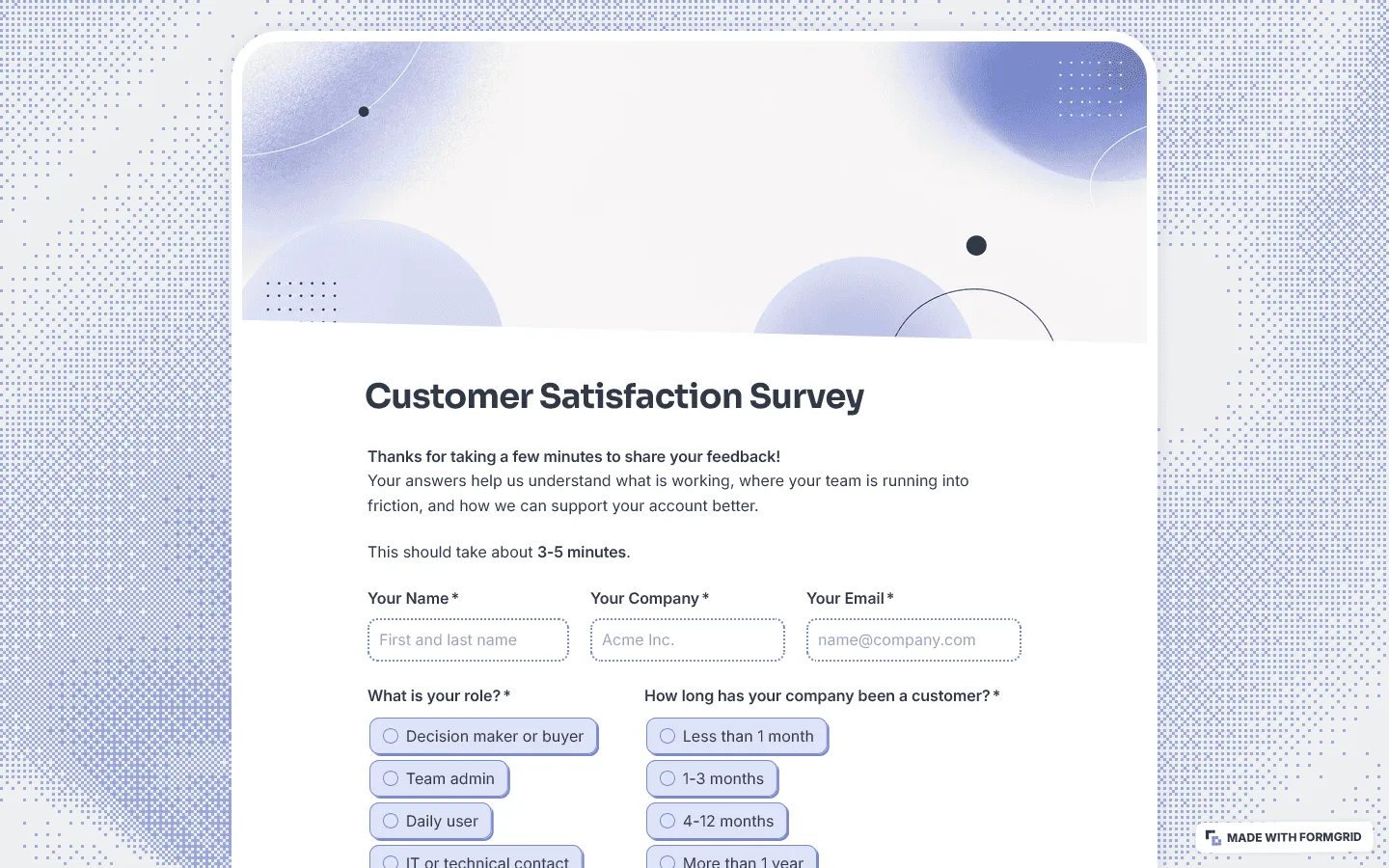
For a ready-made starting point, use this customer satisfaction survey template or this B2B customer satisfaction survey template.
2. Net Promoter Score (NPS)
Net Promoter Score, or NPS, measures customer loyalty. It asks how likely someone is to recommend your company. It’s a good fit for quarterly check-ins, account reviews, renewal periods, post-onboarding relationship surveys, and long-term customer research.
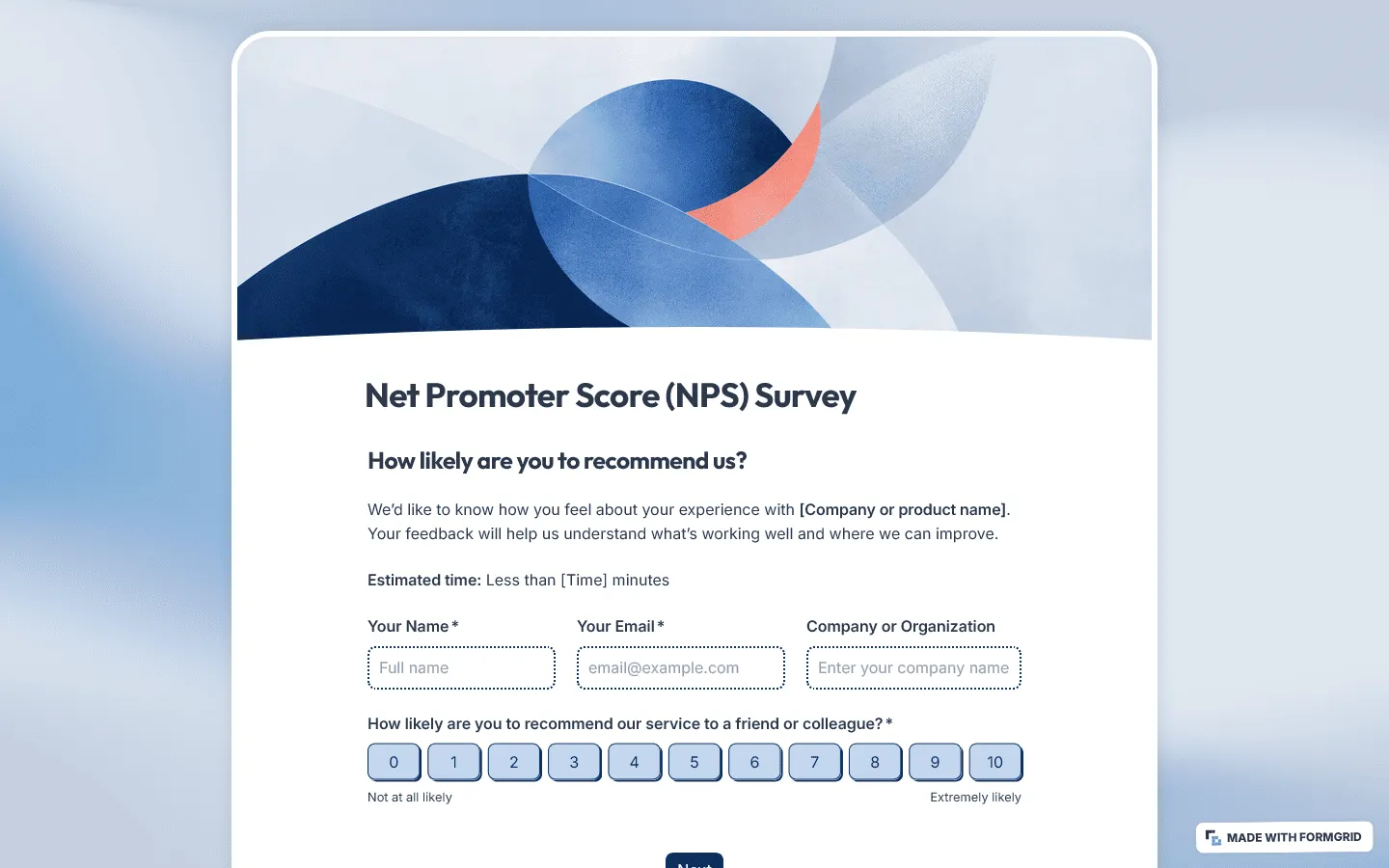
The standard NPS question is: “How likely are you to recommend us to a friend or colleague?”
Customers answer on a scale from 0 to 10:
- Promoters answer 9 or 10.
- Passives answer 7 or 8.
- Detractors answer from 0 to 6.
Formula: NPS = % promoters - % detractors
If 55% of respondents are promoters and 15% are detractors, your NPS is 40. Passives count toward the total number of responses, but they are left out of the final calculation.
Keep the survey short. Ask the recommendation question, then add one follow-up: “What is the main reason for your score?” or “What would make you more likely to recommend us?”
Use an NPS survey template when you want a simple loyalty survey.
3. Customer Effort Score (CES)
Customer Effort Score, or CES, measures how easy it was for a customer to complete a task. Long waits, repeated explanations, confusing instructions, and unclear next steps all make an experience feel harder than it should. It is useful to measure the CES after support, checkout, setup, booking, returns, account updates, onboarding, and self-service flows.
A CES question usually asks something like:
- How easy was it to get the help you needed?
- How easy was it to complete setup?
- How easy was it to resolve your issue?
CES is usually reported as an average score. If customers rate ease from 1 to 5 and the average response is 4.1, your CES is 4.1 out of 5. Add one follow-up question to make the score useful: “What made this harder than expected?” or “What would have made this easier?”
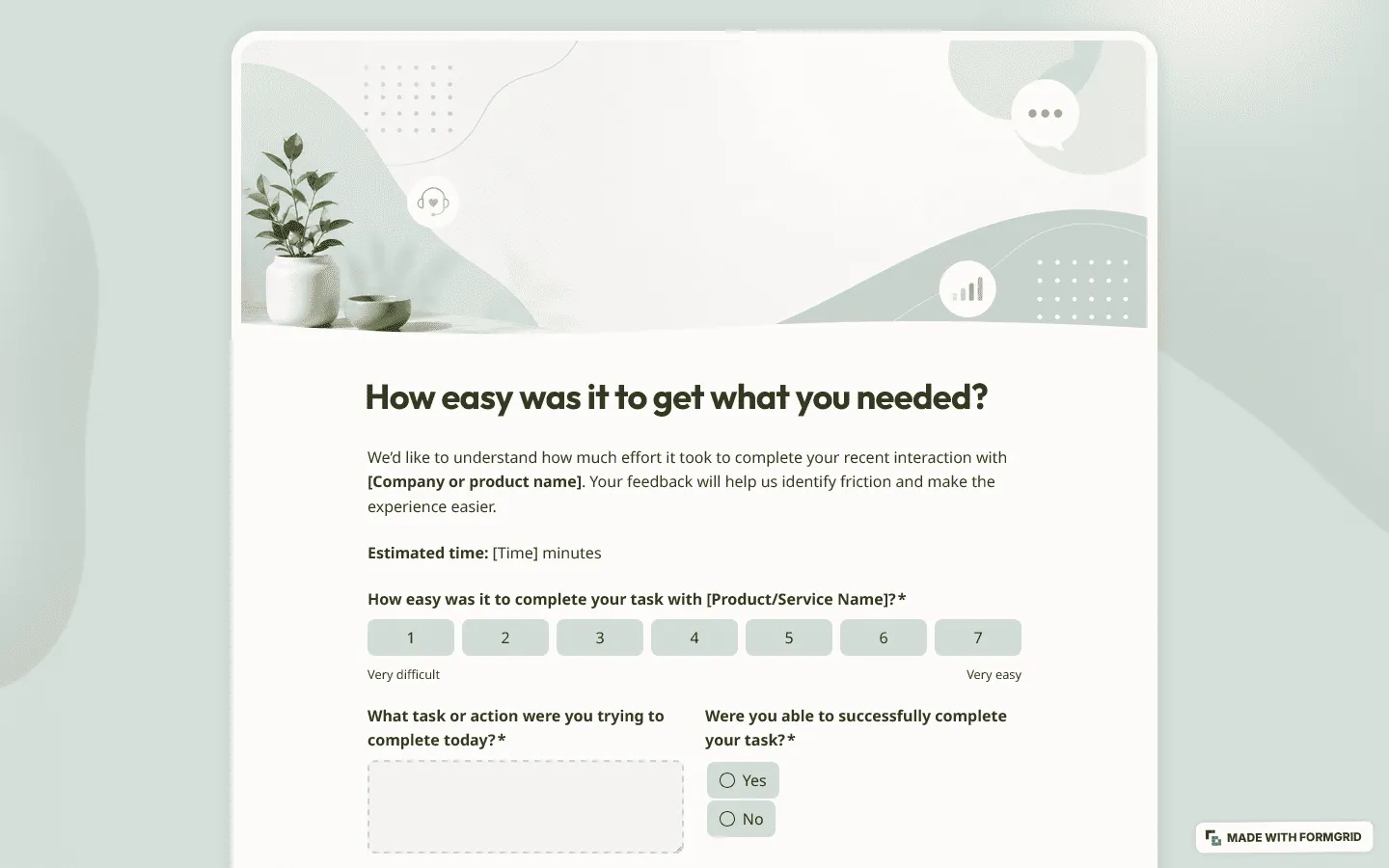
Use the customer effort score survey template when friction is the main thing you need to understand.
4. Customer feedback surveys
A customer feedback survey platform can give you more context than a single metric. They can include ratings, multiple-choice questions, open-ended questions, file uploads, follow-up permission, and questions about specific parts of the customer experience.
This format works well when you need to understand the reason behind satisfaction or dissatisfaction. A product team might ask what feels confusing or missing. A service business might ask about communication, quality, timeline, and value. A customer success team might ask whether onboarding made the next step clear.
A customer feedback survey can include CSAT, NPS, or CES, but it should still have one main purpose. Pick the template that matches the kind of feedback you need:
- Customer feedback form template for general comments, suggestions, issue details, and follow-up permission
- Product feedback form template for usability, bugs, missing features, and product improvements
- Client feedback form template for project work, communication, quality, timelines, and results
- Customer experience survey template for feedback across several touchpoints
- Customer onboarding feedback survey template for setup, training, handoff, and first value
For help planning the structure, read how to create a feedback form.
5. Online reviews
Online reviews can reveal satisfaction patterns that surveys miss. They are especially useful for restaurants, hotels, local services, apps, marketplaces, ecommerce, and other businesses where public ratings affect buying decisions.
Reviews are messier than surveys because you do not control the timing, question, or rating scale. That can make them harder to measure, but it also makes them useful. Customers often describe the parts of the experience that mattered most to them in their own words.
Track the rating, then read the comments for repeated themes. One negative review may be an isolated issue. Several reviews mentioning the same wait time, setup issue, billing problem, or service gap point to something worth fixing.
6. Customer complaints
Complaints show where the customer experience failed badly enough for someone to speak up. They can come from support tickets, emails, calls, live chat, refund requests, cancellation messages, billing disputes, social media comments, account reviews, and sales conversations.
Complaint data is harder to compare than survey scores, but it can be very useful when you track it consistently.
A simple complaint review should capture:
- what the issue was about
- how serious it was
- how often it happened
- which team can fix it
- which customers were affected
Like with reviews, the pattern is what matters most here. A single complaint may need a personal follow-up. Repeated complaints point to a process issue.
Our customer complaint form template can help you collect complaint details, route issues by category, and give customers a clear way to ask for follow-up.
7. Behavioral signals
Surveys tell you what customers say. Behavioral signals show what customers do.
These signals are especially useful for SaaS, subscriptions, memberships, ecommerce, marketplaces, and service businesses with repeat customers. Useful behavioral signals include:
- Usage engagement: how often customers log in, use key features, complete setup, or return after their first session
- Retention rate: how many customers stay over a period of time
- Churn rate: how many customers leave, cancel, or stop buying
- Repeat purchase rate: how many customers buy again
- Referral rate: how often customers recommend you or invite others
- Downgrades or reduced usage: signs that a customer may be getting less value than before
These signals need feedback to explain them. Low usage could mean the customer is confused, blocked, poorly onboarded, or no longer seeing enough value. A high referral rate may point to strong loyalty, but it does not explain what customers value most.
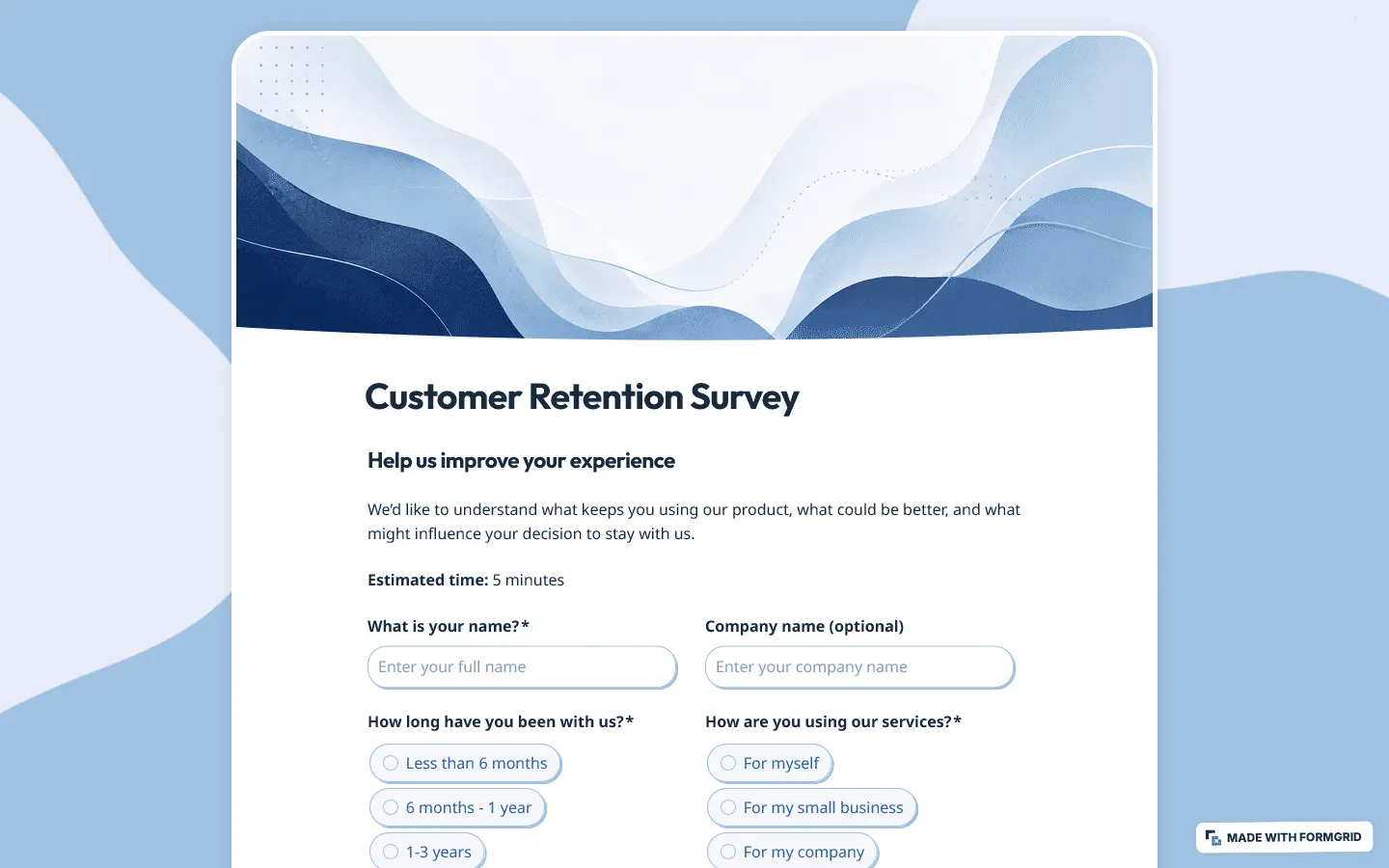
Our customer retention survey template can help you understand the reasons behind renewal, churn, repeat purchase, and usage patterns.
Customer satisfaction metrics and formulas
Use this table as a quick reference for calculating customer satisfaction metrics. The table is about formulas; the sections above explain when each metric makes sense.
| Metric | Question it answers | Formula or calculation |
|---|---|---|
| CSAT | Were customers satisfied with this experience? | Satisfied responses / total responses x 100 |
| NPS | Are customers likely to recommend us? | % promoters - % detractors |
| CES | Was it easy for customers to complete the task? | Average ease rating |
| Customer retention rate | What share of customers stayed? | Customers retained / customers at start x 100 |
| Customer churn rate | What share of customers left? | Customers lost / customers at start x 100 |
| Repeat purchase rate | What share of customers bought again? | Repeat customers / total customers x 100 |
| Complaint rate | How often do customers report problems? | Complaints / customers or transactions |
| Average review rating | How do customers rate us publicly? | Average rating across selected review channels |
| Usage engagement | Are customers actively using the product or service? | Depends on the product: logins, key actions, active days, completed setup, or feature usage |
| Referral rate | How often do customers recommend you? | Referred customers or invites / total customers x 100 |
Keep the wording, scale, timing, audience, and calculation method stable. A CSAT survey sent after every support ticket should keep the same rating scale over time. If the question changes from “How satisfied were you with the support you received?” to “How was your overall experience with our company?”, the trend no longer measures the same thing.
Why measuring customer satisfaction matters
Customer satisfaction often changes before revenue does. Customers may use the product less, reorder less often, delay renewal conversations, contact support more, abandon tasks, or mention the same frustration in reviews.
Measuring satisfaction helps you catch those signals while there is still time to respond.
It shows where the experience is breaking
Different metrics point to different problems:
| Signal | What it may point to |
|---|---|
| Low CSAT after support | The answer was unclear, slow, incomplete, or unhelpful |
| Low CES after setup | The process took too much effort |
| Poor onboarding feedback | The customer does not feel clear or confident yet |
| Low NPS | The wider relationship may be weak |
| Low renewal confidence | The customer may not see enough value to continue |
| Repeated complaints | A process, product, or communication issue needs attention |
That context matters. A low rating by itself is hard to act on. A low rating tied to a specific moment tells you where to look.
It explains customer behavior
Revenue and usage data can show that something changed. Satisfaction feedback helps explain why.
A customer who stops using a product may be confused, blocked, disappointed, busy, missing a feature, or unsure how to get value. A customer who leaves a low support rating may be reacting to speed, tone, clarity, effort, or an unresolved issue.
Those are different problems. They need different fixes.
It helps teams prioritize
Customer satisfaction data becomes more useful when patterns repeat.
One bad response may need a personal follow-up. Ten comments about the same billing issue, setup step, delivery delay, support handoff, or missing feature point to a process problem.
It also makes ownership clearer:
- Support can review unclear replies or unresolved issues.
- Product can investigate confusing workflows or missing features.
- Customer success can follow up with at-risk accounts.
- Operations can review delivery, scheduling, or service quality.
- Marketing and sales can adjust promises that set the wrong expectations.
It shows whether changes worked
After you change something, satisfaction data helps you check the result.
If you rewrite onboarding emails, onboarding confidence should improve. If you change support handoffs, support CSAT or CES should move. If you clarify delivery updates, fewer customers should mention uncertainty or delays.
The trend matters because it shows whether the same issue keeps coming back.
When to measure customer satisfaction
Survey timing depends on what the customer is able to judge. Ask after the outcome is clear, but before the details fade.
| Customer moment | When to send the survey | Best metric |
|---|---|---|
| Support ticket | After the issue is resolved | CSAT or CES |
| Live chat or phone call | Right after the conversation ends | CSAT |
| Checkout or booking | Right after completion | CES |
| Delivery | After the order has arrived | CSAT |
| Appointment or service visit | Same day or next day | CSAT |
| Onboarding | After the first meaningful setup milestone | CSAT or CES |
| Account review | Before or right after the review | NPS or customer experience survey |
| Renewal | Before the customer has made a decision | Retention survey or NPS |
| Cancellation | Right after cancellation | Cancellation survey |
For one-off interactions, ask while the details are fresh
Transactional surveys work best when they are tied to a recent experience. Good timing depends on the outcome:
- Support: after the issue is resolved
- Delivery: after the customer has received the order
- Service visit: the same day or next day
- Checkout or booking: right after completion
- Onboarding: after the customer reaches a real setup milestone
The main mistake is sending the survey before the customer can judge the result. A support survey sent before the issue is solved will not tell you much. A delivery survey sent before the order arrives is just noise.
For relationship surveys, use a slower rhythm
Relationship surveys need more time. Customers need enough experience with your product, service, or team to judge the full relationship.
This is where NPS, customer experience surveys, and account health surveys make more sense. Common timing includes:
- quarterly or twice-yearly check-ins
- before account reviews
- after the customer has used the product for a few months
- before renewal planning
- after a few completed appointments, projects, or billing cycles
For retention risk, ask before the decision is final
Retention surveys are most useful before the customer has fully decided whether to stay. Send them before renewals, subscription end dates, repeat purchase windows, or account reviews.
This gives customers a chance to tell you what is making them hesitate, such as unclear value, low usage, setup issues, missing features, weak support, pricing concerns, or internal approval problems.
Customer satisfaction survey questions to ask
Good customer satisfaction survey questions are clear, neutral, and tied to a real experience. The customer should understand exactly what they are rating.
General satisfaction questions
Use these when you want to understand how a specific customer experience went:
- How satisfied were you with your experience?
- How satisfied were you with the product or service?
- How well did the experience meet your expectations?
- What is the main reason for your rating?
- What could we have done better?
Customer service questions
Use these after support tickets, chats, calls, or customer success conversations:
- How satisfied were you with the support you received?
- Was your issue resolved?
- How clear was the response?
- How easy was it to get help?
- What could have made the support experience better?
Customer effort questions
Use these when the customer had to complete a task or solve a problem:
- How easy was it to get what you needed?
- How easy was it to complete this task?
- Did anything make the process harder than expected?
- What would have made this easier?
Onboarding questions
Use these after setup, kickoff, implementation, training, or first use:
- How clear was the onboarding process?
- Did you understand the next step?
- How helpful was the training or guidance?
- How confident do you feel using the product or service?
- What would have made onboarding easier?
Loyalty and retention questions
Use these for NPS, renewal, repeat purchase, or account health surveys:
- How likely are you to recommend us?
- How likely are you to continue using us?
- What keeps you coming back?
- Are you considering other options?
- What would make you more confident staying?
Client satisfaction questions
Use these after a project, milestone, retainer period, or client review:
- How satisfied were you with the project or service?
- How would you rate communication during the project?
- How would you rate the quality of work?
- Did the project meet your expectations?
- What would make future work together smoother?
Use conditional logic to keep the survey short. A low CSAT score can show a question about what went wrong. A high score can show a question about what worked well. A customer who agrees to follow-up can see contact fields. A customer who is considering alternatives can see a question about what would make them stay.
How to turn customer satisfaction data into action
Customer satisfaction data is useful when it changes what your team does next. Review the results in this order:
-
Handle urgent responses first. Start with low scores, serious complaints, and customers who ask for follow-up. These are the responses most likely to need a direct reply.
-
Compare results by segment. Break feedback down by customer type, plan, location, product, support channel, onboarding stage, or account owner. Overall scores can hide where the real problem is.
-
Group comments into themes. Tag repeated issues like billing, setup, delivery, support quality, missing features, unclear instructions, or pricing concerns. Patterns are easier to act on than scattered comments.
-
Assign ownership. Decide who should handle each recurring issue. Support may own unclear replies, product may own confusing workflows, operations may own delivery problems, and customer success may own at-risk accounts.
-
Check whether the fix worked. Keep watching the same metric after making a change. If the same issue keeps appearing in comments, the customer experience has not really improved yet.
Common mistakes when measuring customer satisfaction
Even simple customer satisfaction surveys can produce weak data if the setup is unclear.
Asking too many questions
A survey that tries to measure satisfaction, loyalty, product feedback, pricing, support, onboarding, testimonials, and retention will feel heavy. It will also be harder to analyze because the purpose is unclear.
Start with one main goal. Add only the questions that support that goal.
Measuring too late
Customers may not remember the details of a support interaction several weeks later. Transactional surveys should be sent while the experience is still fresh.
Delayed feedback can still be useful for relationship surveys, but it is weaker for specific interactions.
Only surveying happy customers
Some teams only survey customers who completed the desired path: successful setup, completed delivery, finished onboarding, or renewal. That makes satisfaction look better than reality.
Include customers who had support issues, returns, cancellations, failed setup, low usage, or unresolved questions.
Using vague questions
“How are we doing?” may sound friendly, but it does not tell you what to improve. Tie the question to a real moment whenever possible: support, purchase, onboarding, delivery, product use, appointment, renewal, or project completion.
Treating the score as the full answer
A CSAT score of 82% does not tell you what to fix. The comments, customer segment, touchpoint, and trend make the number useful. Scores are easier to report, but the open-ended answers usually explain what should change.
Changing the question too often
If you keep changing the wording, scale, timing, or audience, your trends become less reliable. Improve the survey when needed, but keep the core metric stable enough to compare results over time.
Customer satisfaction survey templates
The right template depends on what you want to measure:
- Customer satisfaction survey template for a general CSAT survey
- Customer feedback form template for broader comments and suggestions
- Customer service survey template for support feedback
- Customer effort score survey template for measuring friction
- Customer experience survey template for the wider customer journey
- Customer onboarding feedback survey template for setup, training, and first value
- Customer retention survey template for renewal, repeat purchase, and churn risk
- NPS survey template for loyalty and likelihood to recommend
- Product feedback form template for usability, bugs, and feature feedback
- Client feedback form template for project or service work
- Restaurant feedback form template for dining feedback
- Hotel feedback form template for guest feedback
- Customer complaint form template for specific issues that need review or follow-up
Customer satisfaction measurement FAQs
What is the best way to measure customer satisfaction?
The best starting point is a short CSAT survey sent after a specific customer experience. Ask one satisfaction rating question, then ask why the customer gave that rating. Add NPS, CES, retention surveys, reviews, complaints, and support data when you need a broader view.
What are the main customer satisfaction metrics?
The main customer satisfaction metrics are CSAT, NPS, CES, customer retention rate, churn rate, repeat purchase rate, complaint rate, and average review rating. CSAT, NPS, and CES are survey metrics. Retention, churn, complaints, and reviews add behavioral and public feedback signals.
What is the difference between CSAT, NPS, and CES?
CSAT measures how satisfied a customer was with a specific experience. NPS measures how likely they are to recommend your company. CES measures how easy it was to complete a task or get help. CSAT is best for specific moments, NPS is better for loyalty, and CES is better for friction.
How do you calculate customer satisfaction?
The most common CSAT formula is satisfied responses divided by total responses, multiplied by 100. On a 1 to 5 scale, many teams count 4 and 5 as satisfied responses. Some teams report the average rating instead. Choose one method and keep it consistent.
What is a good customer satisfaction score?
A good customer satisfaction score depends on the industry, audience, survey timing, and question wording. Your own trend is usually more useful than a generic benchmark. A score that rises over time shows improvement. A score that drops after a process change deserves attention.
How many questions should a customer satisfaction survey have?
For transactional CSAT, three to five questions is usually enough. Ask one rating question, one reason question, one specific follow-up, and optional follow-up permission. Longer relationship surveys can include more questions, but each question should have a clear purpose.
How often should you measure customer satisfaction?
Measure transactional satisfaction right after the experience, such as support, delivery, purchase, onboarding, or service completion. Measure relationship satisfaction less often, such as quarterly, twice a year, annually, or before renewal. Avoid sending surveys so often that customers start ignoring them.
Can small businesses measure customer satisfaction without expensive software?
Yes. A simple form can work well for small volumes, especially when the survey is short and the team reviews every response. A dedicated customer satisfaction survey tool becomes more useful when you need automation, integrations, trend reporting, or surveys triggered by support, purchase, onboarding, or renewal events.