Customer Retention Survey Template
Free customer retention survey template for understanding why customers stay and what puts them at risk.
Need a custom retention survey?
Describe what you want to find out and FormGrid will create a tailored survey template for you.
About this customer retention survey template
Customer retention feedback should help you understand why people keep choosing you, not only whether they are satisfied right now. A customer may like the product or service but still be unsure about renewing, buying again, or continuing because of price, value, support, missing features, poor fit, internal changes, or better alternatives.
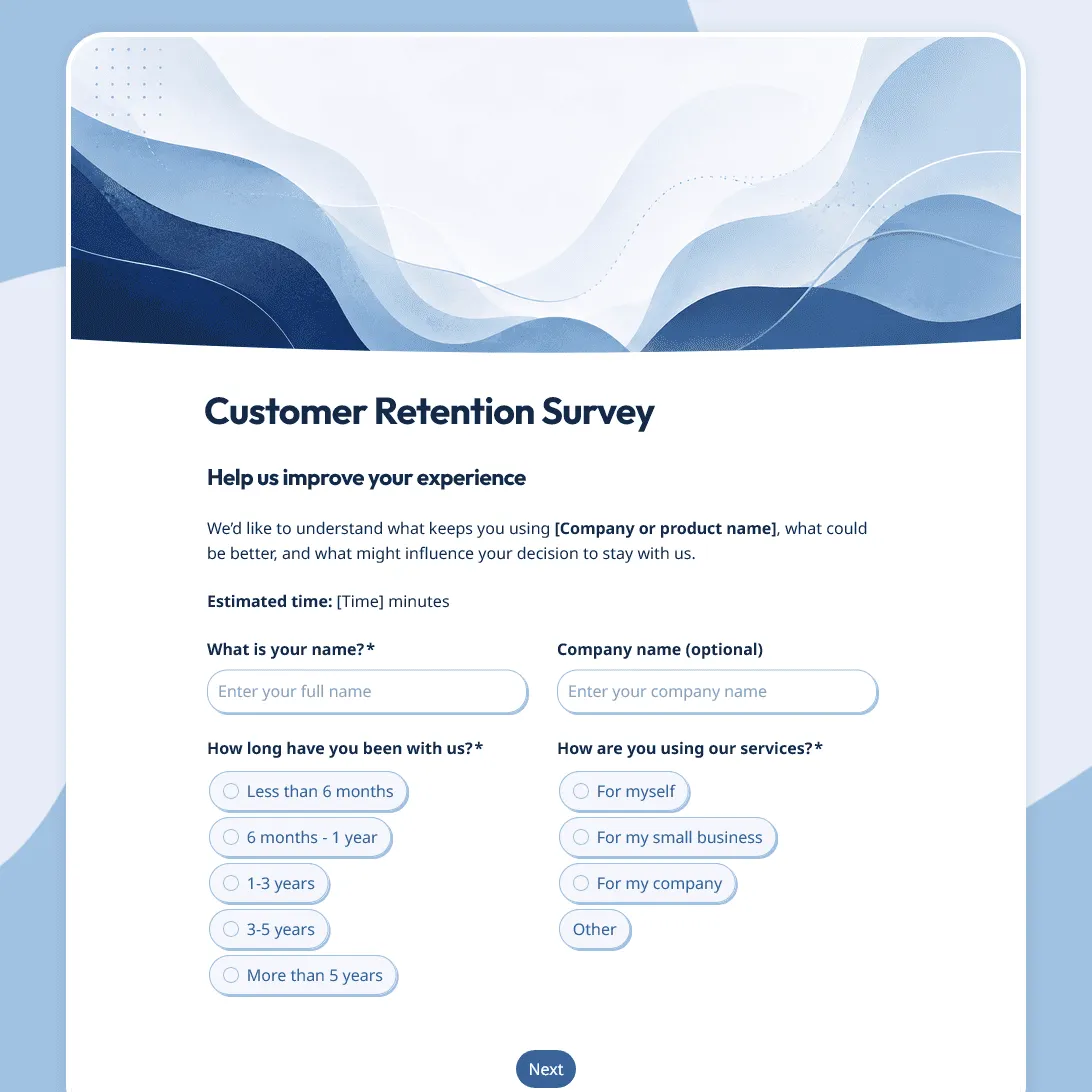
This customer retention survey template helps you spot the signals behind loyalty and churn risk. It asks what customers value, what gives them doubts, what could make the relationship stronger, and whether they are likely to continue.
Use this template before renewals, after a few months of product use, during account reviews, after a drop in activity, before a subscription ends, after a repeat purchase cycle, or as part of a customer success check-in.
What this template includes
This customer retention survey helps you collect:
- Customer type or account role
- Length of customer relationship
- Product, service, plan, or account being reviewed
- Main reason for using your business
- Perceived value
- Satisfaction with recent results
- Likelihood to renew, repurchase, or continue
- Reasons the customer stays
- Friction, concerns, or unmet needs
- Whether the customer is considering alternatives
- What would make them more likely to stay
- Follow-up permission
- Optional contact details
Shape the form around the retention question you need to answer. For a SaaS company, that might mean renewal confidence, product adoption, missing features, support experience, or team rollout. For a service business, it might mean results, communication, pricing, trust, future needs, or whether the client sees enough value to continue.
You can ask the AI chat in FormGrid to make the survey fit a specific retention moment. For example: “Make this a renewal check-in for annual SaaS accounts” or “Turn this into a repeat-customer survey for a service business.”
How to use this template
Click “Use this template” to open the customer retention survey in FormGrid.
-
Choose the retention moment. Decide whether the survey is for upcoming renewals, repeat purchases, inactive customers, account reviews, subscription check-ins, or customers who have shown signs of churn risk.
-
Ask who is answering. For consumer customers, you might ask whether someone is a first-time buyer, repeat customer, subscriber, or member. For business customers, ask whether they are the buyer, admin, account owner, daily user, or decision maker.
-
Focus on value. Satisfaction matters, but retention usually depends on whether the customer feels the product, service, or relationship is still worth the cost, time, and effort.
-
Ask what keeps them around. Include a question about the main reason they continue using your product or service. This can reveal what customers value most and what should be protected.
-
Make it easy to mention doubts. Ask about friction, missing needs, pricing concerns, support gaps, internal changes, or alternatives. Keep the wording calm so customers can be honest without feeling pushed toward a complaint.
-
Ask what would make them more likely to stay. This question is often more useful than asking why they might leave. It gives your team something concrete to improve, offer, clarify, or follow up on.
-
Create paths for different retention signals. Use conditional logic to show different follow-ups for loyal customers, undecided customers, and at-risk customers. You can also ask the AI chat to add paths such as: “Ask customers who are unsure about renewing what would help them decide.”
-
Ask before collecting contact details. If you want to follow up with at-risk customers, ask for permission first. Then show name, email, company, account, order, or subscription fields only when they agree.
-
Set expectations after submission. Use a custom end page to thank customers and explain whether their feedback will be reviewed, whether someone may contact them, or where they can get help.
-
Share the survey before the decision point. After you publish it, send the survey before renewal, before a subscription expires, after a usage drop, after an account review, or when a repeat purchase would normally happen. You can also place it in a customer portal or account page with an embed code.
When answers come in, separate loyalty signals from risk signals. Reasons people stay can guide messaging, onboarding, support, and product priorities. Reasons people hesitate should be sorted by what your team can act on now, such as pricing confusion, missing education, unresolved support, unclear value, or feature gaps.
If at-risk responses need attention, add a send email block so the right person sees them quickly. For example, renewal concerns can go to customer success, product gaps can go to product, and unresolved service issues can go to support or account management.
Tips for customer retention surveys
A useful retention survey should help you understand the decision to stay, renew, repurchase, or leave.
-
Send it before the customer has already decided. Feedback after cancellation can help, but retention surveys are strongest when there is still time to clarify value, fix a problem, or offer support.
-
Ask about value in plain language. Customers may not think in terms of ROI or retention risk. Ask whether the product or service is helping them get what they came for.
-
Separate happy from loyal. A customer can be satisfied today and still switch later. Ask about continued use, renewal confidence, repeat purchase intent, or whether they are considering other options.
-
Listen for silent churn signals. Low usage, unclear value, missing internal buy-in, slow support, and “we have not had time to use it” can matter as much as direct complaints.
-
Give loyal customers a voice too. Ask long-term or repeat customers what keeps them coming back. Those answers can strengthen onboarding, sales pages, customer stories, and retention messaging.
-
Do not turn every risk signal into a sales pitch. Sometimes the right next step is support, education, a better handoff, a product fix, or a clearer explanation of value.
Related guides and resources
Customer retention survey template FAQs
When should I send a customer retention survey?
Send it before a renewal, subscription end date, account review, repeat purchase window, or expected reorder date. You can also send it when activity drops, support issues increase, or a customer has not engaged in a while.
What should a customer retention survey ask?
Ask why the customer uses your product or service, what value they get, what keeps them around, what feels frustrating, whether they are likely to continue, and what would make them more confident staying. For business customers, ask who is answering because buyers, admins, and daily users may see different risks.
How is this different from a customer satisfaction survey?
A customer satisfaction survey measures how happy customers are with an experience, product, or service. A retention survey goes further by asking whether they are likely to stay, renew, repurchase, or continue, and what could affect that decision.
How is this different from a customer experience survey?
A customer experience survey looks across the wider customer journey. A retention survey focuses on the decision to continue. It is especially useful before renewals, account reviews, subscription endings, or repeat purchase moments.
Can I use this survey for B2B customers?
Yes. For B2B customers, ask about role, team adoption, value, support, onboarding, internal buy-in, renewal confidence, and what could make the account more successful. Use wording like “your team” when the response should reflect more than one person’s experience.
Should I ask whether customers are considering competitors?
Yes, if the question fits your relationship with the customer. Keep it optional and neutral. For example, ask whether they are considering other options, then ask what is driving that consideration.
What should I ask customers who might leave?
Ask what is making them unsure, what they expected, what would need to change, and whether they are open to follow-up. Keep the path short. A customer who is already at risk should not have to complete a long survey before someone helps them.
Can I show different questions for loyal and at-risk customers?
Yes. Use conditional logic to show different follow-ups based on renewal intent, satisfaction, account role, usage, or whether the customer is considering alternatives. Loyal customers can see questions about what keeps them coming back, while at-risk customers can see questions about blockers and follow-up.
Can I alert my team when a customer is at risk?
Yes. Add a send email block for answers that need quick attention. You can route renewal concerns to customer success, product gaps to product, billing concerns to operations, and unresolved issues to support.
How should I review retention survey results?
Group answers by the reason customers stay or hesitate. Look for patterns around value, pricing, missing features, support, onboarding, usage, internal buy-in, or alternatives. For deeper analysis, export responses and compare results by plan, segment, account size, renewal date, product, or customer owner.
Is this customer retention survey template free?
Yes. You can use this template for free and collect unlimited customer retention survey responses on the free plan.
Related templates
Customer Satisfaction Survey Template
Free customer satisfaction survey template for measuring customer experience, product quality, support, delivery, value, and likelihood to return.
Customer Experience Survey Template
Free customer experience survey template for understanding the customer journey, including first impressions, onboarding, support, value, friction, and loyalty.
Customer Feedback Form Template
Use this free customer feedback form template to collect ratings, comments, suggestions, NPS, contact details, and follow-up consent.