12 Best Employee Engagement Survey Tools in 2026
Employee engagement surveys are one of the simplest ways to understand how people actually feel about their work.
Run them well and you catch problems early: a team drifting, a manager losing trust, a role that stopped making sense. Run them poorly and you get silence, or worse, numbers that look fine until someone quits.
Many companies now rely on employee engagement survey tools to collect this feedback regularly. These platforms help teams run pulse surveys, track sentiment over time, and identify problems before they turn into turnover.
In this guide, we compare the best employee engagement survey software, from simple form builders to full HR platforms.
Best employee engagement survey tools compared
If you want a quick overview before diving into the details, this table compares the most popular employee engagement survey tools based on pricing, free plans, and their main strengths.
| Employee survey tool | Best for | Free plan | Starting price |
|---|---|---|---|
| FormGrid | Visually unique, engaging surveys | Available | $29/month |
| Lattice | Comprehensive performance management | Not available | $15/user/month |
| Leapsome | Performance and engagement tracking | Not available | Custom |
| Workleap | Simple pulse surveys and feedback | Not available | $6.25/user/month |
| ThriveSparrow | Peer recognition and appreciation | Not available | $3/user/month |
| Typeform | Conversational surveys | Available | $25/month |
| SurveyMonkey | Deep survey analysis and benchmarking | Available | $25/month |
| Tally | Simple, doc-style forms | Available | $29/month |
| Deel | Global, distributed teams | Not available | Custom |
| Microsoft Forms | Microsoft 365 users | Available | Free |
| Culture Amp | Employee experience and analytics | Not available | Custom |
| Qualtrics | Enterprise experience management | Available | Custom |
What is employee engagement software?
Employee engagement software helps organizations measure how employees feel about their work environment, leadership, and overall job satisfaction.
Most platforms rely on employee surveys, pulse surveys, and feedback loops to gather insights across teams. The goal is to identify patterns that signal problems early, such as declining morale, burnout, or communication breakdowns.
Some tools focus purely on collecting survey responses, while others combine engagement surveys with performance reviews, recognition systems, and analytics dashboards. The right platform depends on whether you simply want to gather feedback or manage the broader employee experience.
Our criteria: How we evaluated these tools
When reviewing these tools, we focused on how easy they make it to collect feedback from busy teams. The best platforms reduce friction for employees while giving managers clear data they can act on.
We evaluated each tool based on:
- Ease of use: How quickly teams can create and launch employee surveys without complex setup.
- Pulse surveys: Support for short, recurring surveys to track engagement trends over time.
- Anonymous feedback: Safeguards like minimum response thresholds that protect employee anonymity.
- eNPS support: Built-in employee Net Promoter Score questions and reporting.
- Segmentation: Ability to analyze results by department, location, tenure, or role.
- Analytics: Clear reporting and trend tracking across multiple survey cycles.
- Integrations: Delivery through tools like Slack or Microsoft Teams to increase response rates.
- Anonymity and privacy: Employees need to feel safe giving honest feedback. If people suspect their manager can see who said what, they’ll just click ‘satisfied’ on everything and move on.
- Pricing: We considered the value provided across different budget levels, including free options.
12 best employee engagement survey tools and platforms
1. FormGrid
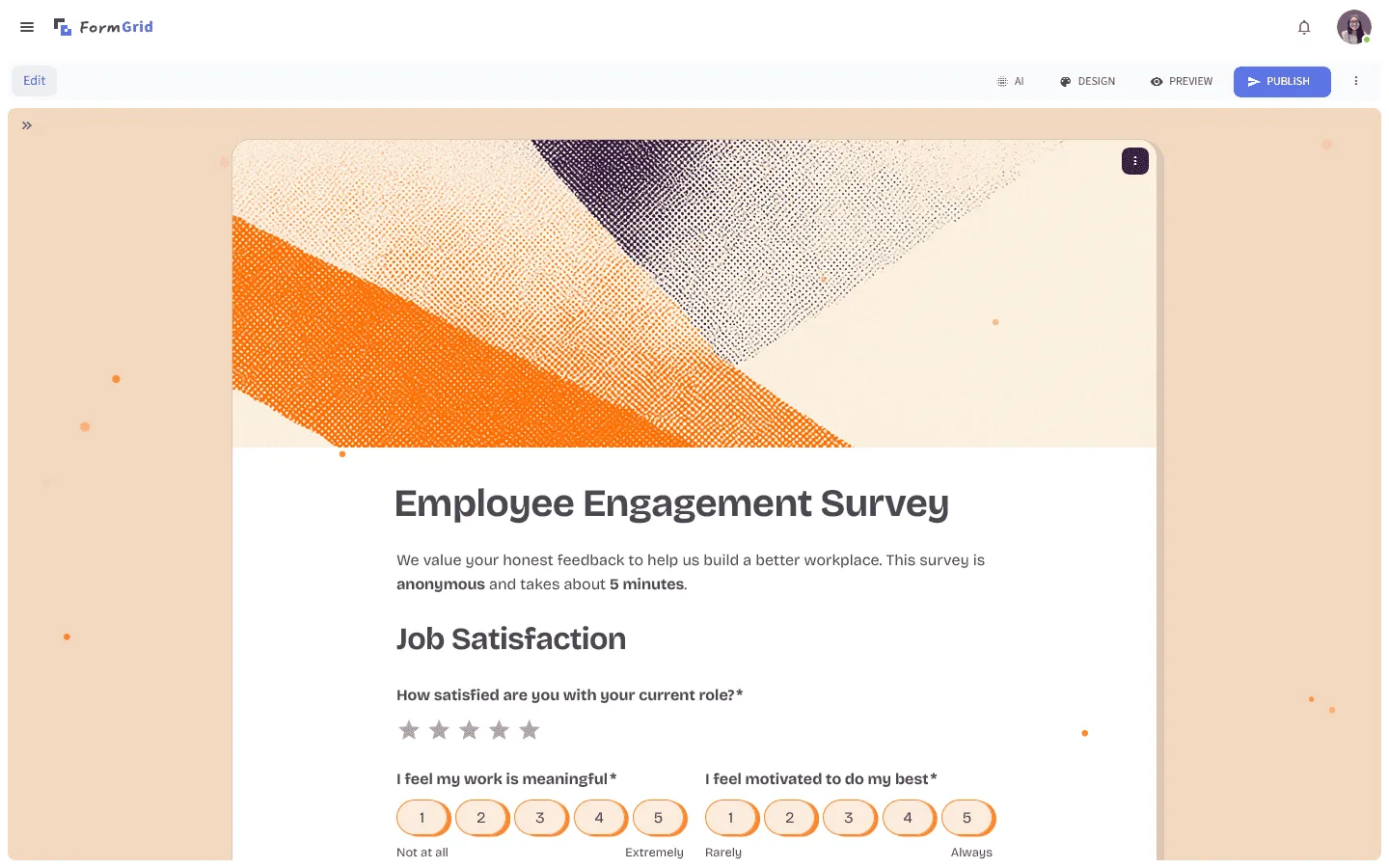
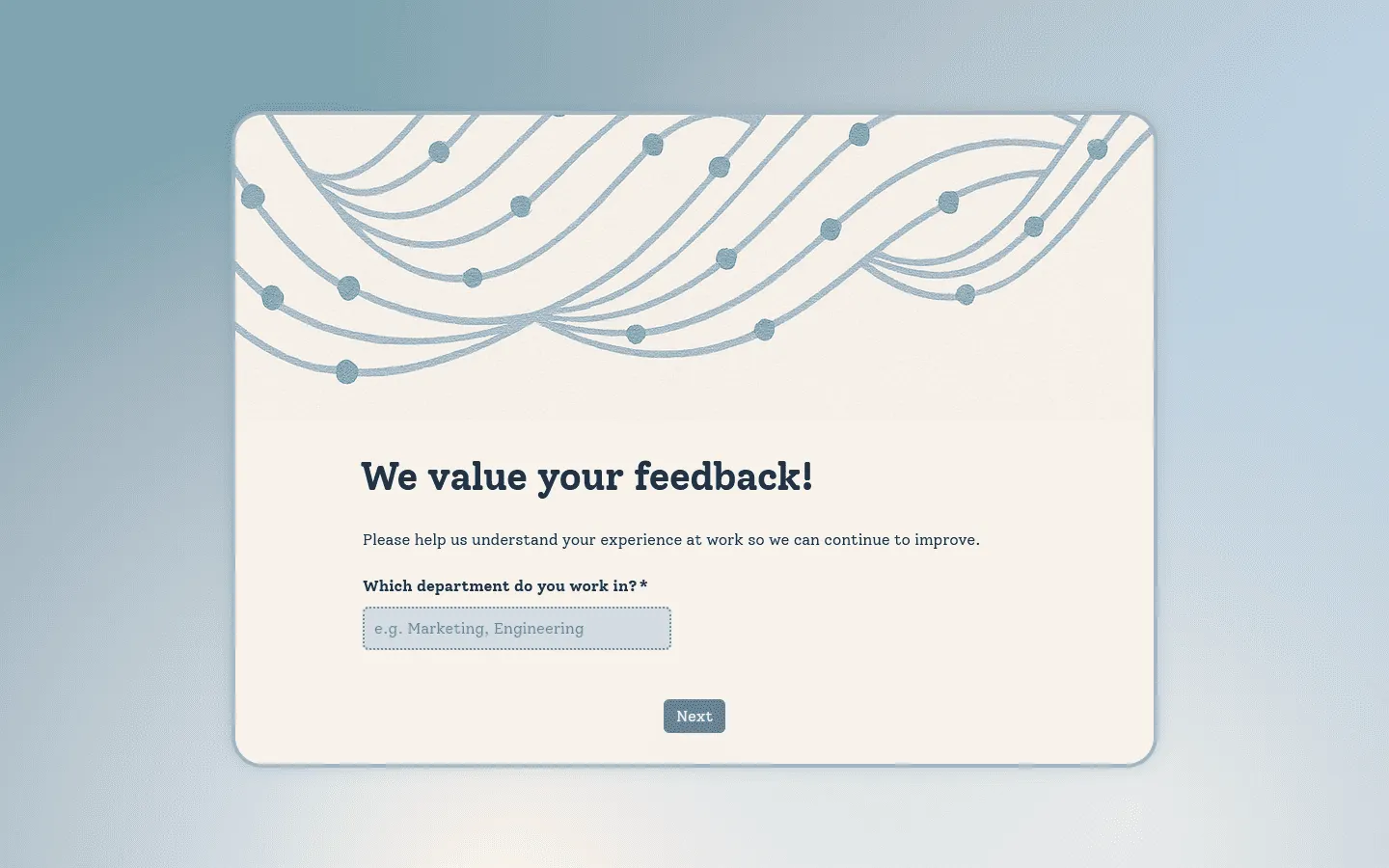
When running employee engagement surveys, presentation matters. If a survey looks like a tedious corporate mandate, response rates will suffer. FormGrid approaches form building differently, giving you complete control over the layout and presentation to create surveys that feel engaging and unique.
Instead of forcing a rigid structure, FormGrid lets you build your survey freely on a grid. You can place questions side-by-side, add context next to specific items, and incorporate images or sections wherever they fit best. This lets you design surveys that feel closer to a small interactive page than a standard form.
Start with a free employee feedback survey template, staff satisfaction survey template, or employee pulse survey template, depending on whether you want broad feedback, satisfaction tracking, or a shorter check-in. You can also generate a fully custom form with a unique design from a short prompt.
FormGrid does not impose limits on usage. You get unlimited forms and responses for free, making it a highly practical choice for companies that run frequent pulse surveys and want a reliable tool without recurring per-user fees.
Pros
- Complete design freedom to create engaging surveys
- AI-generated forms and themes to speed up creation
- Zero cost for full features and unlimited responses
Cons
- Fewer built-in HR templates than dedicated performance platforms
- Focuses purely on data collection rather than embedded analytics dashboards
FormGrid pricing
- Free: Unlimited forms and responses, access to all core features
- Plus ($29/month): Collaboration, remove FormGrid branding, version history
- Business ($79/month): User roles and permissions, advanced link settings
Why choose FormGrid?
If you want your employee surveys to look modern, engaging, and aligned with your brand, FormGrid is one of the best options. It removes the friction from survey creation and offers unlimited usage for free. Start with a free employee feedback survey template or staff satisfaction survey template. For a step-by-step walkthrough on the process, see the complete guide on how to conduct an employee engagement survey.
2. Lattice
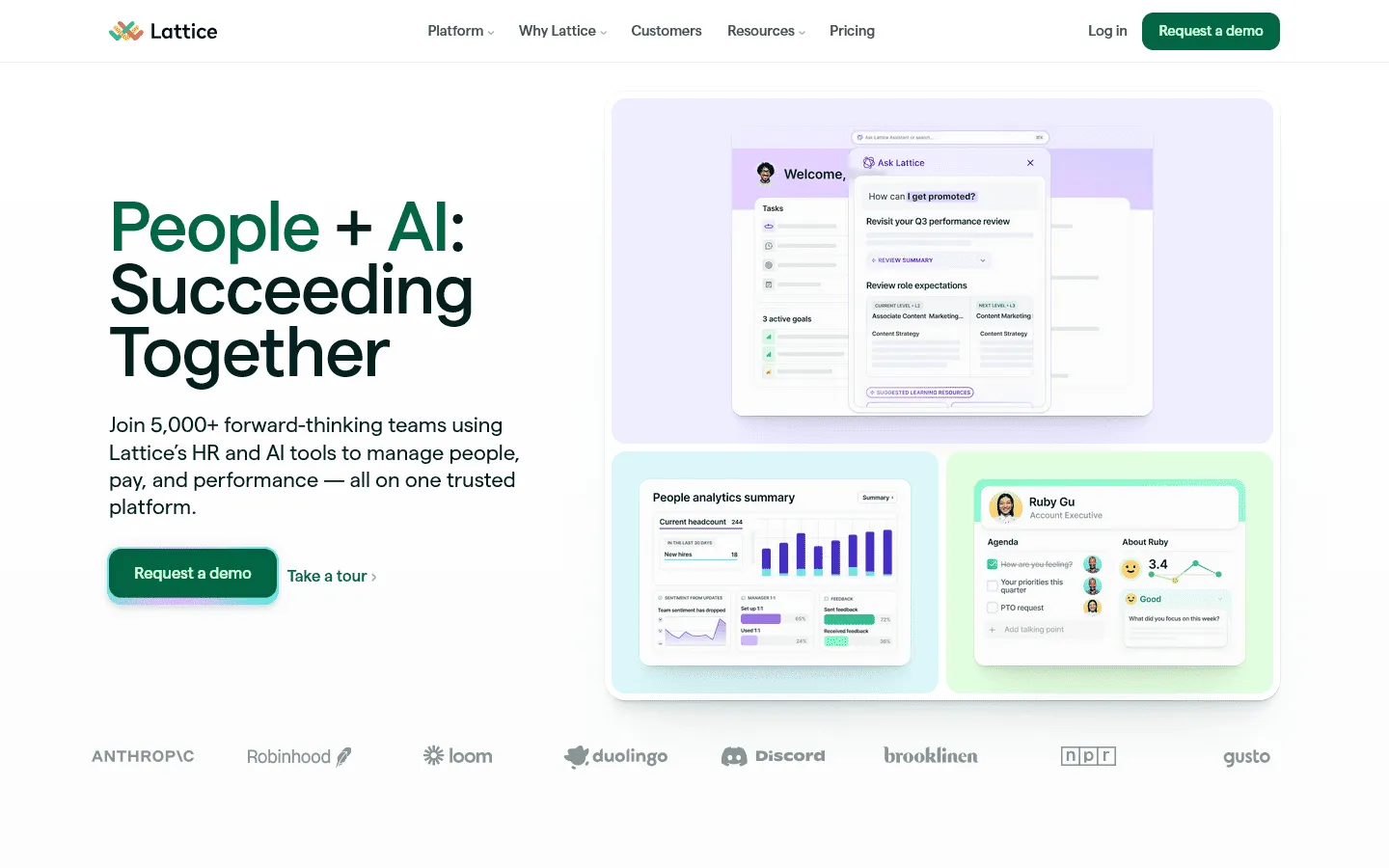
Lattice is built for companies that want engagement data and performance data in the same place. If you’re already running structured review cycles, it slots in naturally. The pulse survey results sit next to 1-on-1 notes and OKR progress rather than living in a separate tab.
The platform includes pulse surveys, eNPS tracking, and detailed analytics that highlight how different teams are feeling over time. By combining these insights with regular 1-on-1s and OKRs, Lattice helps managers see the full picture of an employee’s experience and performance.
Lattice covers a lot of ground, so it tends to work best for mid-sized or larger companies that already run structured performance reviews.
Pros
- Deep integration between engagement data and performance reviews
- Highly detailed analytics and benchmarking
- Strong tools for 1-on-1s and goal tracking
Cons
- Can feel complex to set up and administer
- High cost compared to standalone survey tools
Lattice pricing
- Talent Management + Engagement plan: $15/user/month
Why choose Lattice?
Choose Lattice if you want an all-in-one system for HR. If you need engagement surveys, performance reviews, and OKRs to live in the same place, Lattice is a top-tier choice.
3. Leapsome
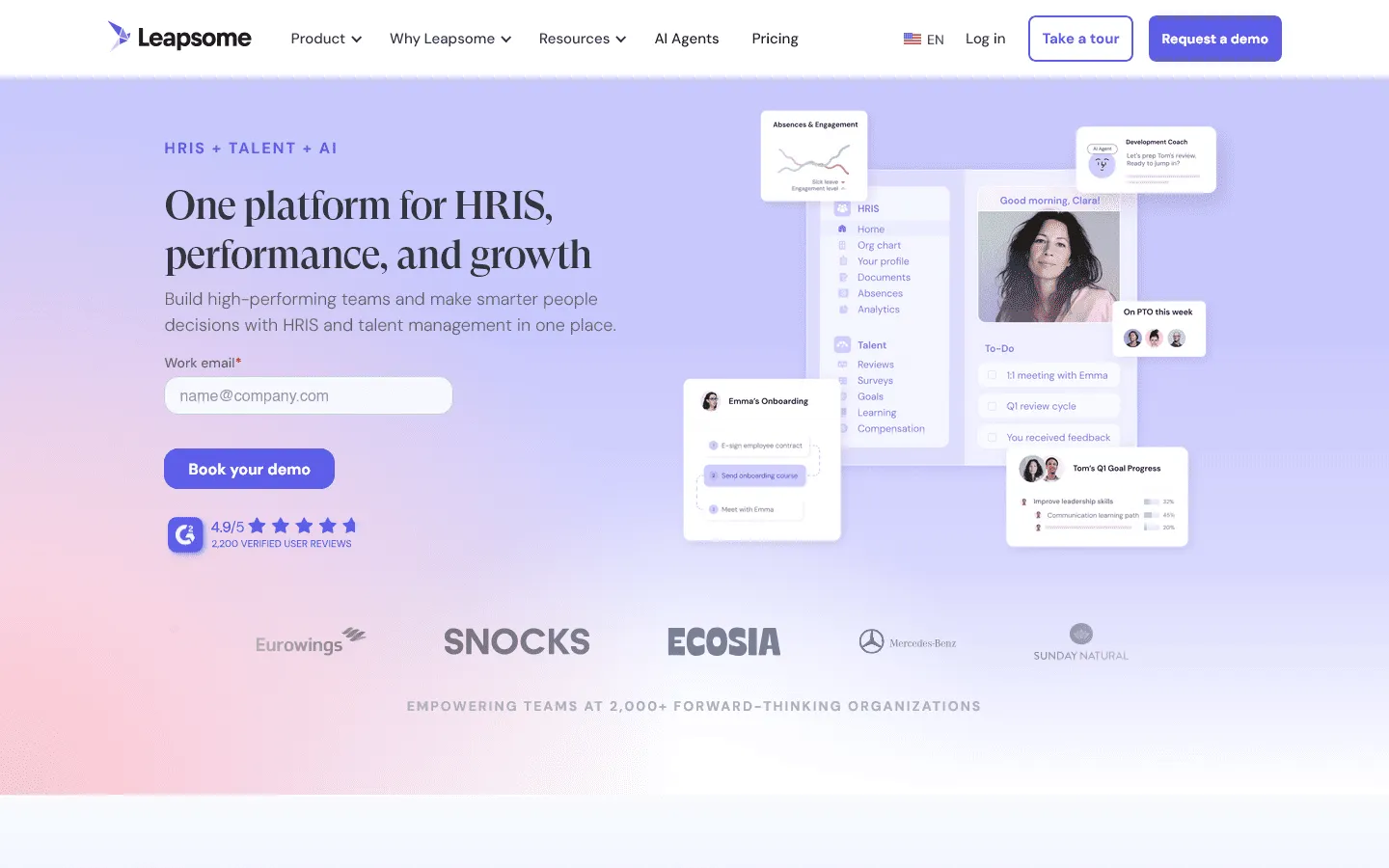
Leapsome focuses heavily on continuous feedback. Employees share input on a rolling basis, and managers can see how sentiment shifts over time instead of waiting for annual reviews. It combines employee surveys, performance reviews, and learning modules into one streamlined platform.
The survey features include customizable templates designed by organizational psychologists, making it easy to measure sentiment accurately. Leapsome’s analytics dive deep into the data, allowing HR teams to segment responses by department, tenure, or location to uncover specific trends.
Its modular pricing allows companies to pick and choose the tools they need, which is helpful for growing teams that might not require every feature immediately.
Pros
- Strong focus on continuous, real-time feedback
- Scientifically backed survey templates
- Modular pricing allows you to only pay for what you need
Cons
- Customization options for performance cycles can be limited
- Advanced analytics have a steeper learning curve
Leapsome pricing
- Custom pricing (contact sales for a quote)
Why choose Leapsome?
Leapsome works best for companies that want engagement surveys tied directly to employee development and training.
4. Workleap
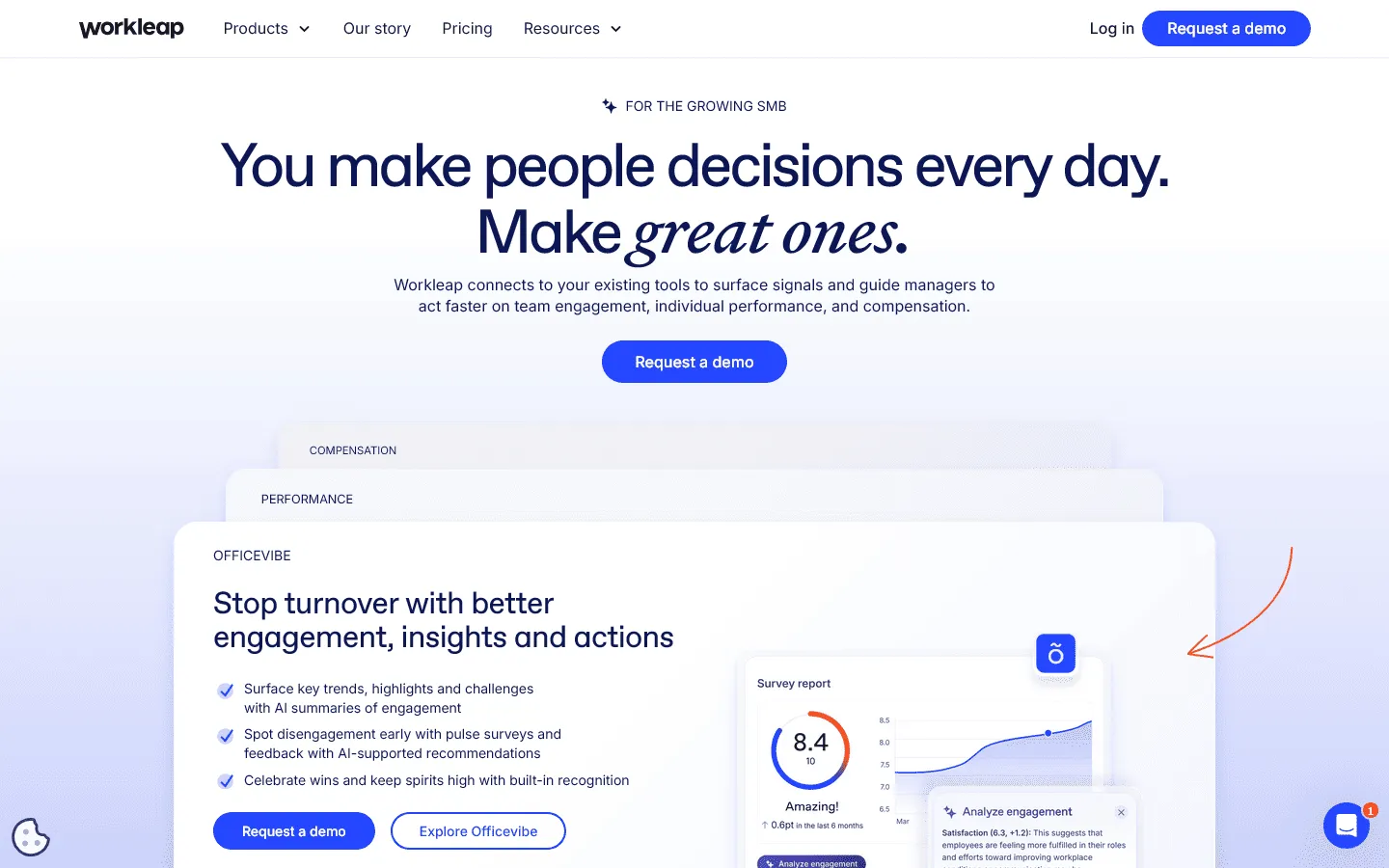
Workleap (formerly Officevibe) is designed primarily to help managers collect feedback and strengthen their teams. It is a feedback-first platform that relies heavily on short, recurring pulse surveys to measure employee sentiment over time.
These pulse surveys are easy to deploy and provide real-time signals without requiring heavy administrative setup. The platform ensures anonymity in a structured way (requiring a minimum number of responses before feedback can be viewed), which helps foster honest communication.
It doesn’t have the performance management depth of Lattice or Leapsome, but that’s not what it’s for. Line managers can run 1-on-1s and peer recognition without needing HR to configure anything.
Pros
- Very easy to set up and use
- Automated pulse surveys ensure consistent data collection
- Built-in coaching prompts to help managers address feedback
Cons
- Lacks a complete performance review mechanism
- Editing goals or OKRs can feel disjointed
Workleap pricing
- Officevibe ($6.25/user/month): Automated pulse and custom surveys
Why choose Workleap?
Workleap is a good fit when the goal is helping managers have better conversations with their teams, not building out a full HR stack. The setup is light and the learning curve is short.
5. ThriveSparrow
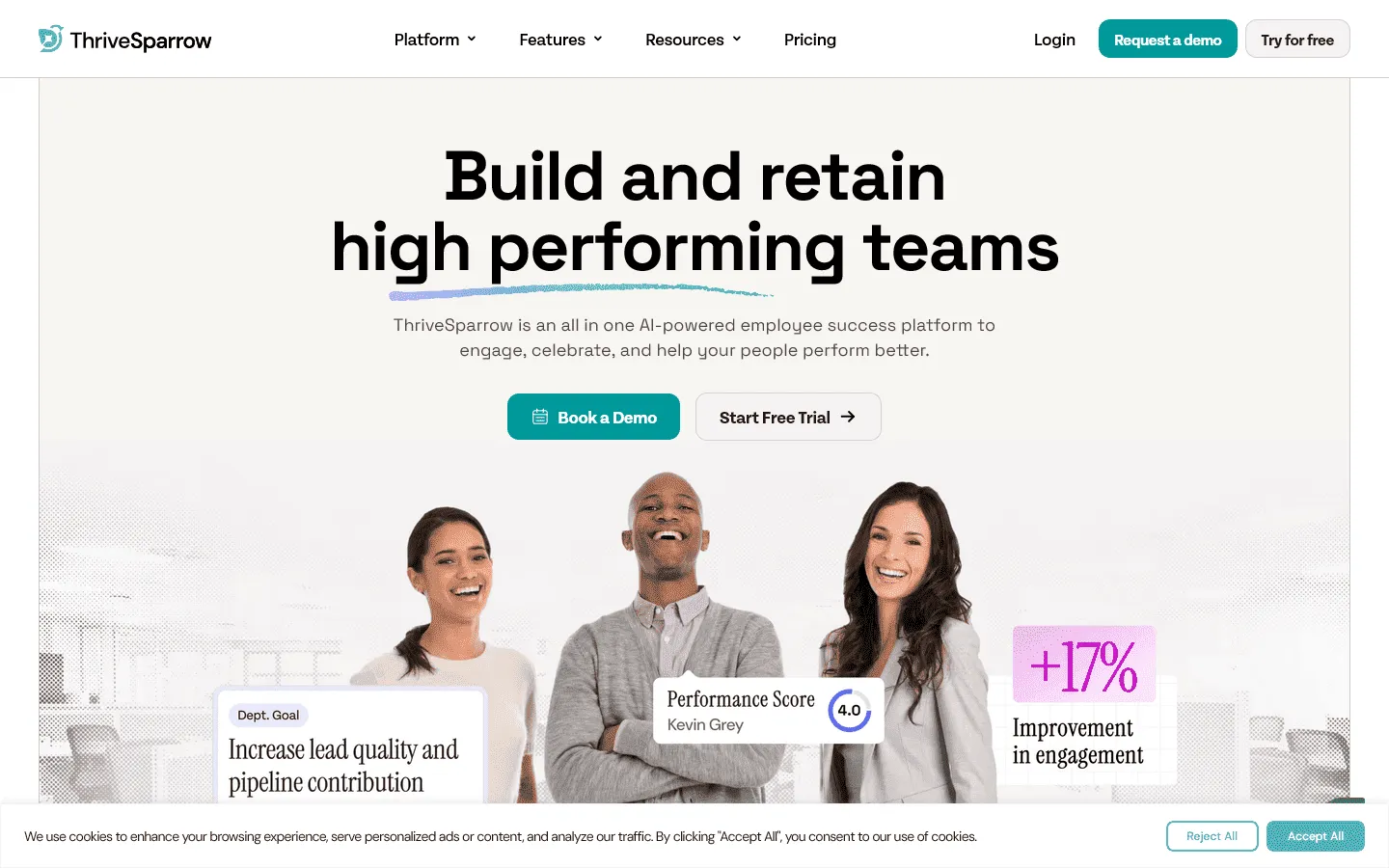
ThriveSparrow focuses on employee engagement through recognition and appreciation. While it includes survey capabilities, its main strength is helping teams build habits around celebrating wins and recognizing peer contributions.
The platform makes it very simple for employees to send digital appreciation cards or highlight great work publicly. Managers can use the tool to run quick temperature checks and gather feedback, tying these insights into recognition initiatives.
ThriveSparrow works best when low morale is the core problem. It nudges teams toward recognizing each other’s work regularly, which tends to shift culture faster than another round of survey data.
Pros
- Very strong focus on building a culture of appreciation
- Easy for employees to understand and adopt quickly
- Affordable pricing model
Cons
- Survey capabilities are secondary to the recognition features
- Less suitable for complex organizational analytics
ThriveSparrow pricing
- Engage ($3/user/month): Automated surveys, sentiment analysis, action plans
Why choose ThriveSparrow?
Pick ThriveSparrow if your engagement strategy relies heavily on peer recognition and you want a simple, affordable way to run supporting surveys.
6. Typeform
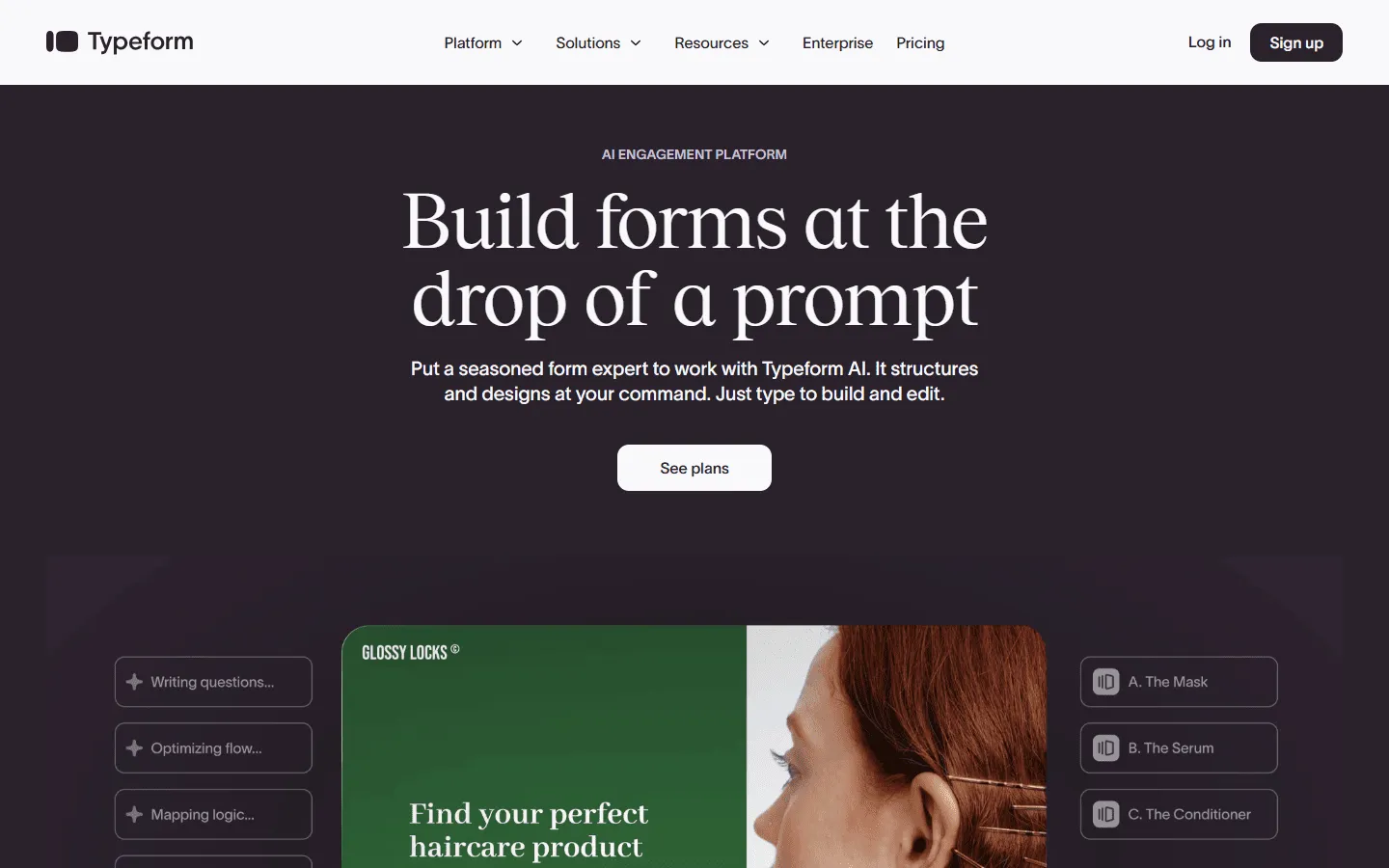
Typeform is widely known for its conversational, one-question-at-a-time survey format. This design approach makes surveys feel less overwhelming, which often leads to higher completion rates compared to traditional, static forms.
For employee engagement, Typeform is a very capable tool when you want to create a highly polished, branded experience. It is particularly useful for one-off surveys, annual reviews, or creative onboarding flows where the visual experience matters.
However, Typeform can get expensive as your response volume grows, and you’ll need to export data to track trends since it lacks built-in HR analytics. If the pricing doesn’t work for your budget, you could explore cheaper Typeform alternatives that offer more scalable tiers.
Pros
- High-quality, conversational user experience
- Beautiful minimal design
- High completion rates for long surveys
Cons
- Can become expensive quickly due to response limits
- No built-in HR analytics or trend tracking over time
Typeform pricing
- Free: 10 responses/month, limited features
- Basic ($29/month): 100 responses/month, basic integrations
- Plus ($59/month): 1,000 responses/month, more logic, branding options, and integrations
- Business ($99/month): 10,000 responses/month, team features, advanced analytics, priority support
- Enterprise (custom pricing): Custom limits, SSO, custom domains, HIPAA compliance
Why choose Typeform?
Choose Typeform when you need to run a highly polished, conversational survey where the user experience is the primary concern, such as an annual company survey.
7. SurveyMonkey
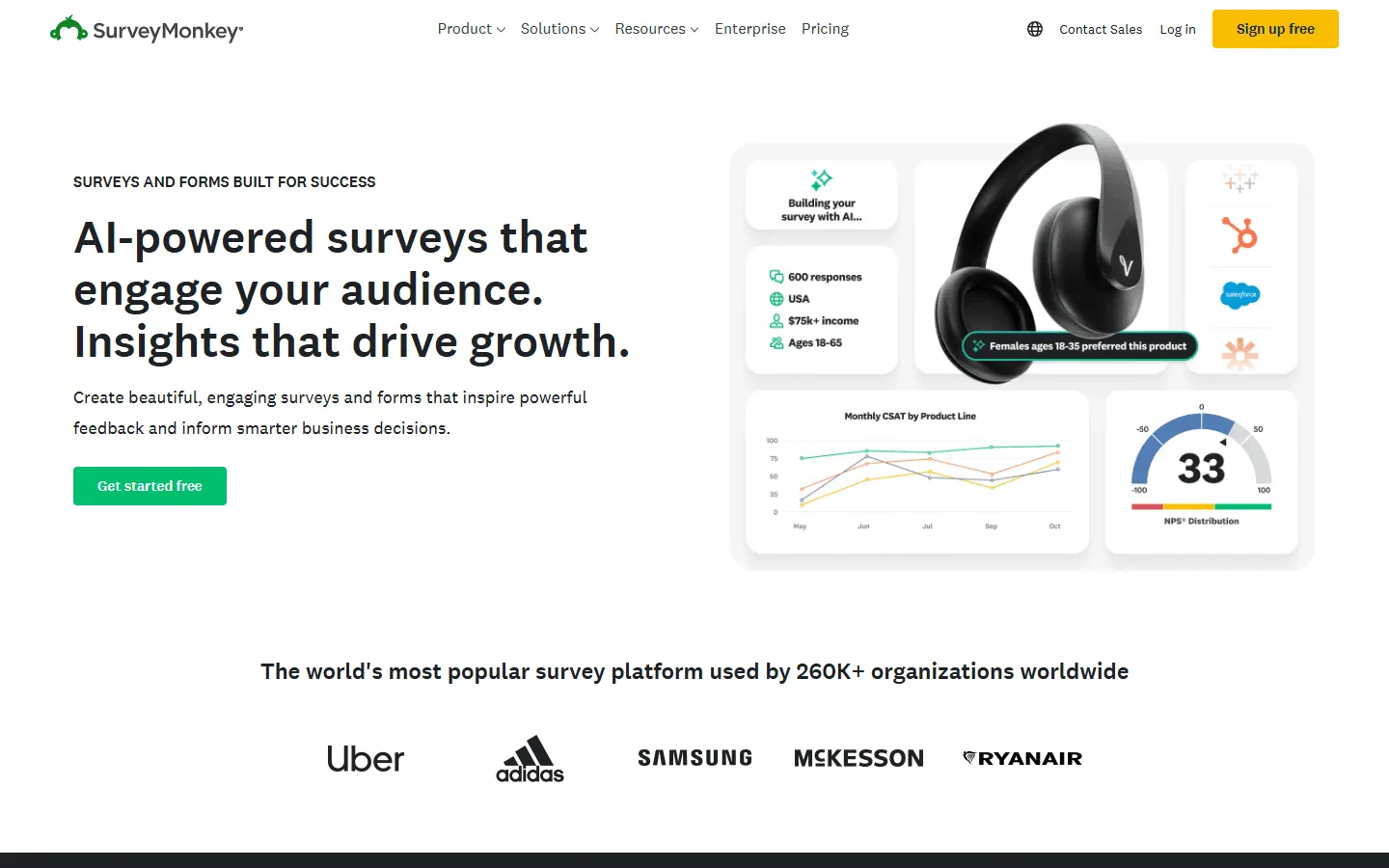
SurveyMonkey is a veteran in the survey space, known for its deep analytical capabilities and extensive question banks. It trades the engaging visual style of newer tools for rigorous data analysis and benchmarking features.
For HR teams conducting complex market research or deep-dive employee engagement studies, SurveyMonkey provides the statistical tools necessary to ensure the data is reliable. It includes expert-certified HR templates and allows you to compare your results against industry benchmarks.
The downside is that the interface feels a bit corporate, and the free plan is very restrictive. If you just want to run quick pulse checks, you might prefer reviewing apps similar to SurveyMonkey that offer a more lightweight experience.
Pros
- Industry-leading data analysis and reporting
- Extensive question bank with validated HR templates
- Ability to benchmark results against industry standards
Cons
- Interface and user experience feel dated
- Very restrictive free plan
SurveyMonkey pricing
- Free: 25 responses/survey, 10 questions/survey, basic features
- Standard Monthly ($39/month): 1,000 responses/month, more question types, custom themes
- Advantage Annual ($432/year): 15,000 responses/year, payments, A/B testing, recurring surveys
- Premier Annual ($1,188/year): 40,000 responses/year, no SurveyMonkey branding, advanced logic
- Team Advantage (~$30/user/month): 50,000 responses/year, collaboration features
- Team Premier (~$75/user/month): 100,000 responses/year
- Enterprise: Custom limits, advanced governance, SSO, HIPAA compliance
Why choose SurveyMonkey?
If you are running complex, data-heavy engagement surveys and need robust statistical analysis and industry benchmarking, SurveyMonkey is the professional choice.
8. Tally
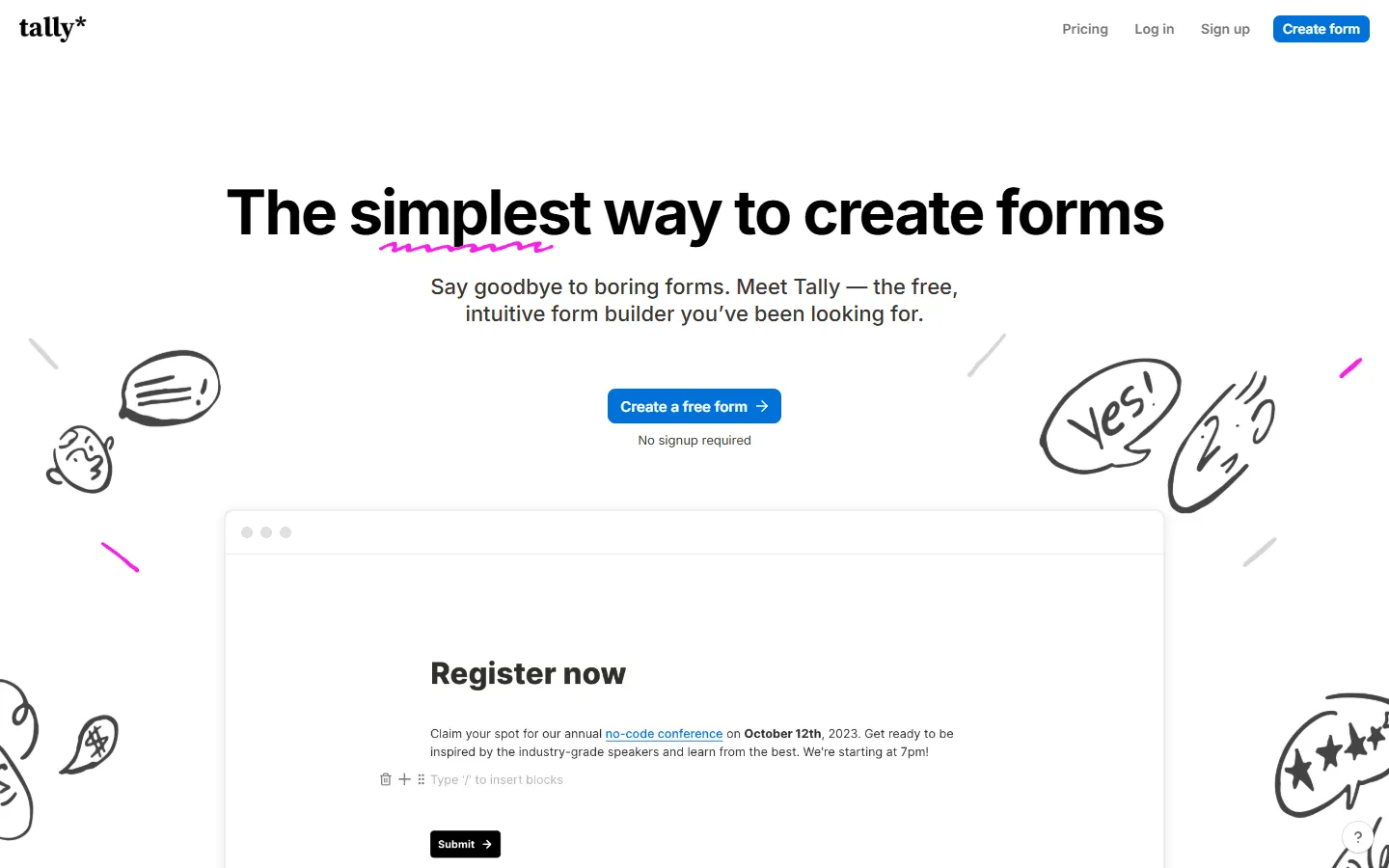
Tally takes a document-style approach to form building. You write questions the same way you’d type a paragraph, so you can put together a new survey fairly quickly.
Like FormGrid, Tally is known for its very generous free plan. You get unlimited forms and responses without paying anything. It doesn’t have complex logic or HR analytics, but that’s the point. You open it, write your questions, and send.
The design is minimal and clean, giving you a no-nonsense way to get answers without a complex setup. But since it doesn’t have advanced logic or HR reporting, you might want to look into tools similar to Tally that offer deeper features if you’re deploying surveys across a larger company.
Pros
- Very generous free plan with unlimited responses
- Fast, document-style editor
- Clean, minimal aesthetic
Cons
- Limited layout customization
- Harder to organize very long, complex surveys
Tally pricing
- Free: Unlimited forms and submissions, basic logic, payments, file uploads
- Pro ($29/month): Custom domains, remove Tally branding, advanced integrations
- Business ($89/month): Email verification, form version history
Why choose Tally?
Switch to Tally if you want a fast, clean survey experience without usage limits, and you do not require built-in HR dashboards.
9. Deel
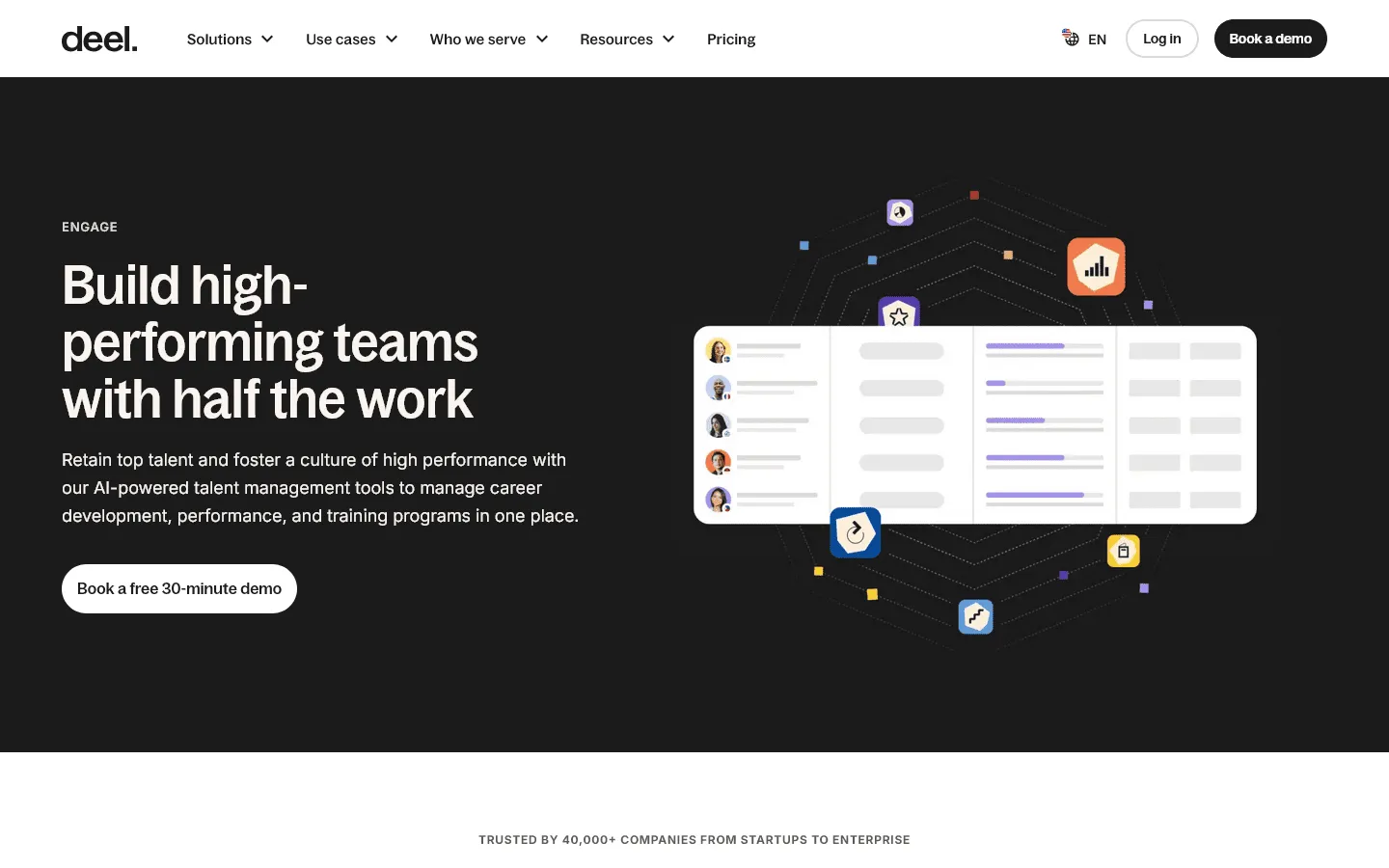
Deel integrates deeply into the workflows of global, distributed teams. Because Deel is known for handling international payroll and compliance, its engagement tools are built with a global workforce in mind.
The platform integrates heavily with Slack and Microsoft Teams, bringing surveys, recognition, and 1-on-1 tools directly into the platforms where employees already communicate. This reduces friction and increases response rates for remote workers.
It covers onboarding, training, and ongoing performance management, so larger international teams don’t need to patch together multiple tools to handle the full employee lifecycle.
Pros
- Excellent integration with Slack and Microsoft Teams
- Built specifically for global, distributed workforces
- Covers a wide range of HR needs in one platform
Cons
- Broad feature set may be too much for smaller teams
- Pricing requires a custom quote and minimum commitments
Deel pricing
- Deel HR Develop ($22/user/month): Engagement & sentiment surveys, performance review cycles, personalized development plans
Why choose Deel?
If your team is distributed across multiple countries and relies heavily on tools like Slack for daily communication, Deel fits into that workflow.
10. Microsoft Forms
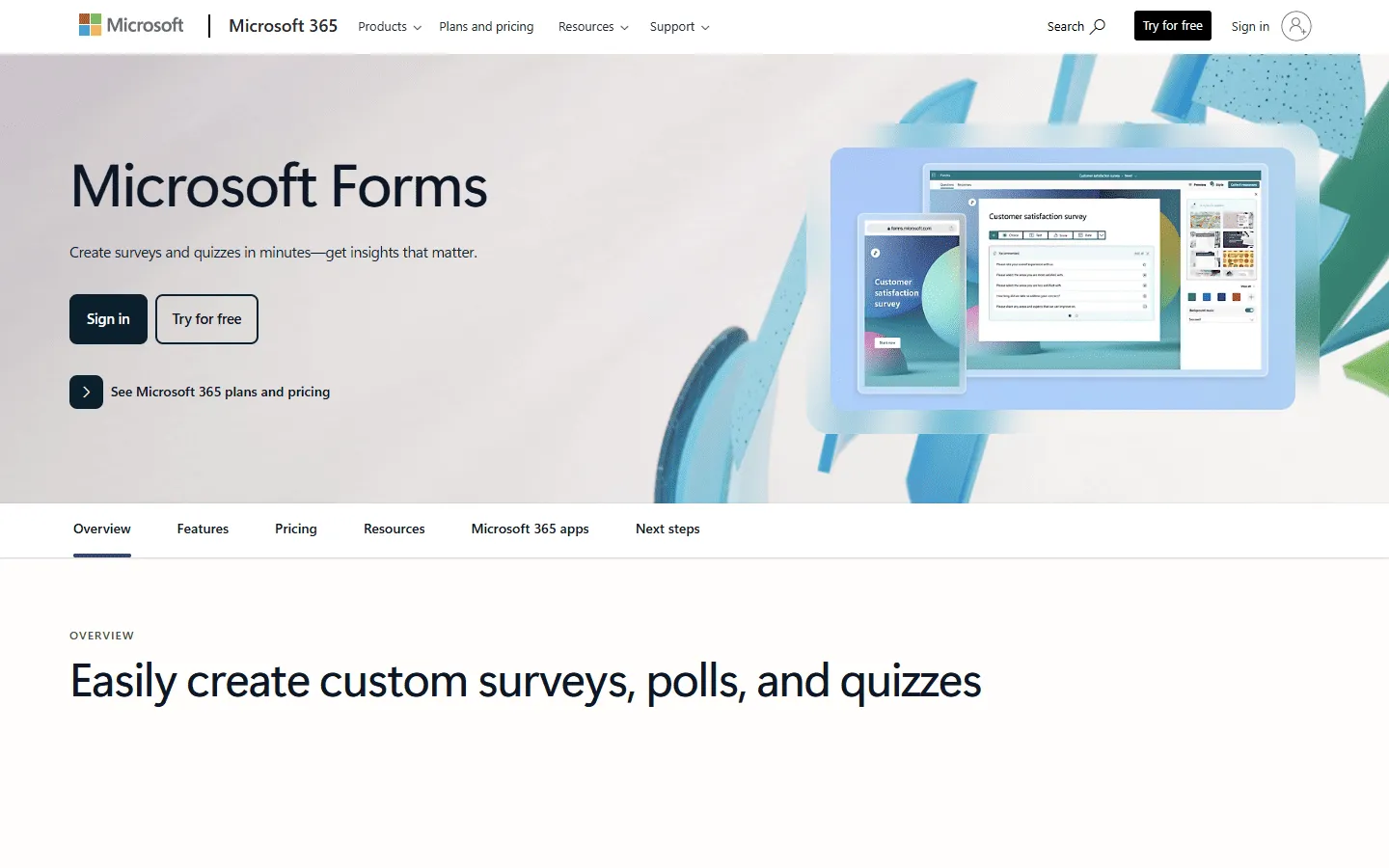 Microsoft Forms is often an easy choice for companies already using Microsoft 365, as the tool is included for free in most enterprise packages. It allows teams to spin up surveys quickly, and the data flows smoothly into Excel for reporting.
Because it is not a dedicated employee engagement platform, you won’t get deep HR analytics or performance tracking out of the box. Instead, you get a fast, secure way to collect data that integrates directly with your existing Microsoft ecosystem.
If you simply want to collect feedback and don’t care about dashboards, Microsoft Forms covers the basics well. That said, if you’re hoping for deep analytics or a heavily customized design, you’re better off checking out more capable Microsoft Forms alternatives instead.
Pros
- Highly secure and included in Microsoft 365
- Connects easily with Excel and Teams
- Straightforward interface
Cons
- Minimal design and customization options
- Lacks dedicated HR analytics or trend tracking
Microsoft Forms pricing
- Free: Included for personal accounts and within Microsoft 365 enterprise packages
Why choose Microsoft Forms?
Choose Microsoft Forms if your company relies heavily on the Microsoft ecosystem and you need a fast, secure way to deploy simple surveys internally.
11. Culture Amp
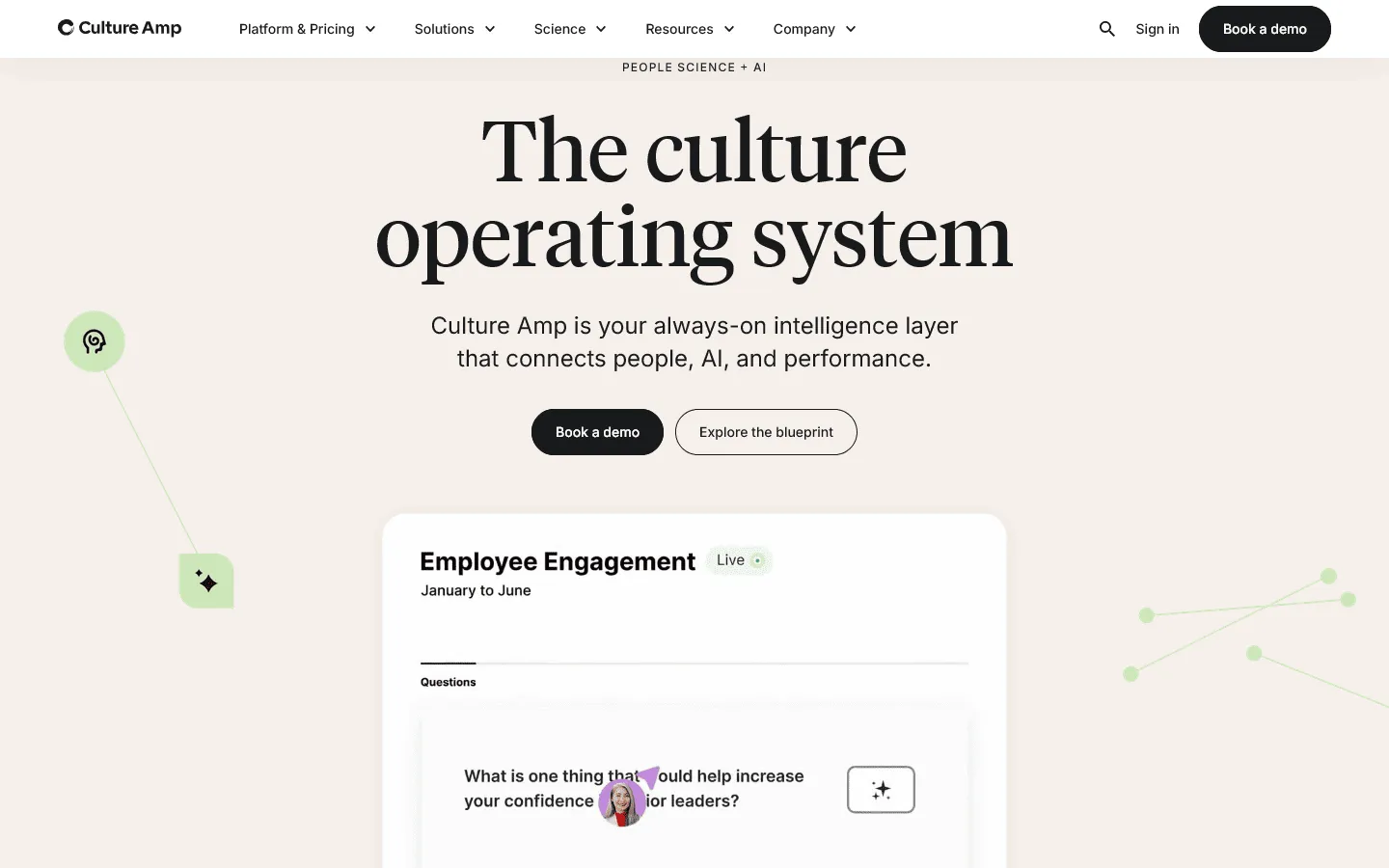
Culture Amp is one of the most well-established dedicated employee experience platforms on the market. It combines engagement surveys, performance reviews, and people analytics in one place, giving HR teams a comprehensive view of how the workforce is doing.
The platform offers a large library of science-backed survey templates, and its analytics are particularly strong when it comes to identifying which factors in the employee experience are most closely linked to retention and performance. Teams can segment data by department, tenure, or location and track changes over time as initiatives are rolled out.
Culture Amp is best suited to mid-size and enterprise companies with dedicated HR or People teams. It is not a lightweight tool, it’s designed for organizations that treat employee experience as a strategic priority.
Pros
- Strong science-backed survey templates and question libraries
- Powerful analytics that connect employee sentiment to business outcomes
- Combines engagement, performance, and development in one platform
Cons
- Enterprise pricing puts it out of reach for smaller teams
- Can feel complex to set up and configure initially
Culture Amp pricing
- Custom pricing (contact sales for a quote)
Why choose Culture Amp?
Culture Amp is the right choice for larger organizations that want to go beyond collecting survey responses and instead use people data to drive strategic HR decisions.
12. Qualtrics
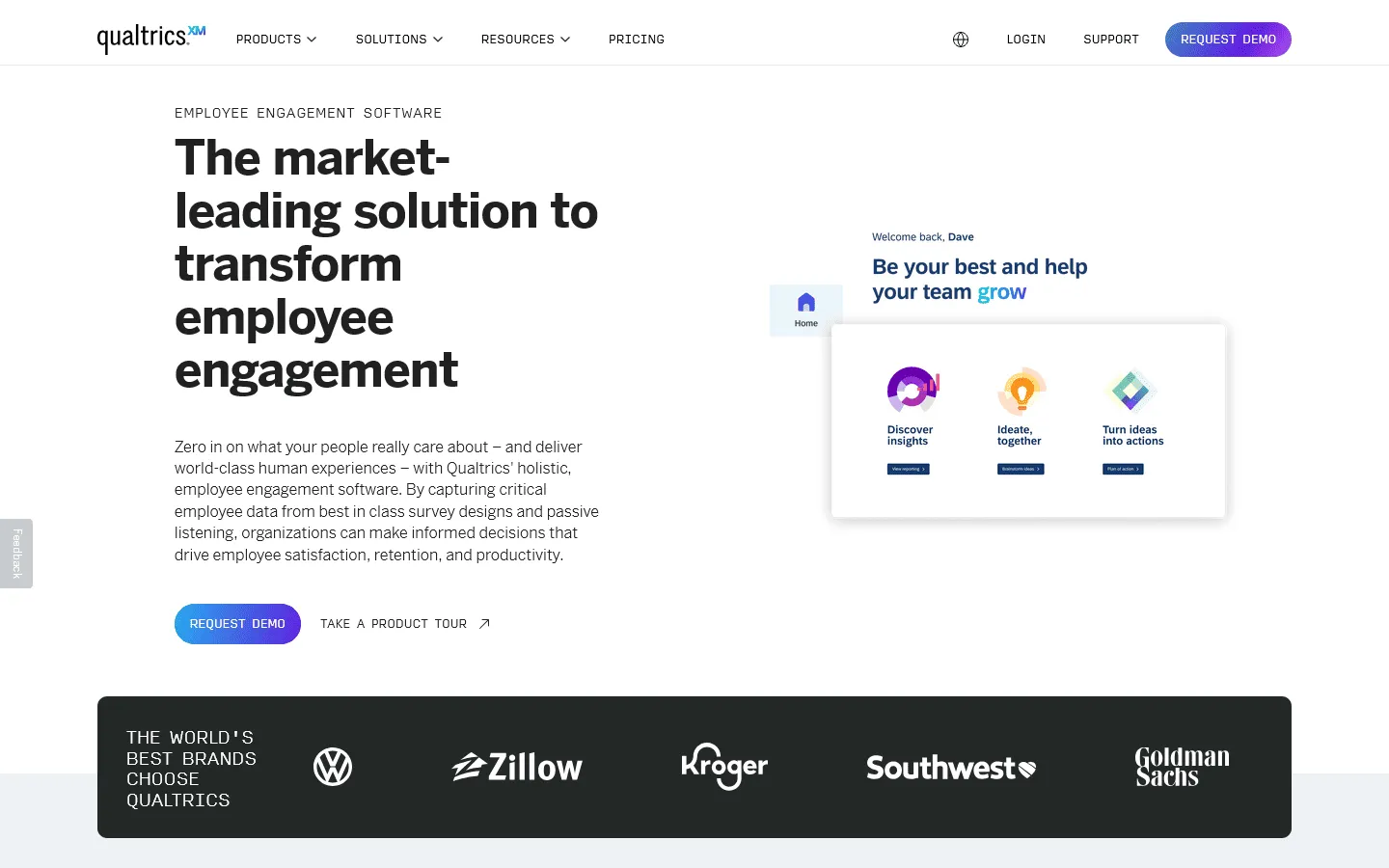
Qualtrics is an enterprise-grade experience management platform. While it covers customer and market research as well, its employee experience module is one of the most advanced available, supporting everything from annual engagement surveys to continuous listening programs and 360-degree feedback.
The platform’s advanced analytics engine can process large volumes of open-ended text responses at scale using AI-driven sentiment analysis. It also offers deep integration with major HRIS platforms, making it a natural fit for large enterprises with complex HR tech stacks.
Qualtrics is overkill for most small and mid-sized businesses, but for large enterprises that need a highly configurable, research-grade survey platform, it is hard to beat.
Pros
- Industry-leading analytics and AI-powered text analysis
- Highly configurable for complex enterprise survey programs
- Deep integrations with major HR platforms and workflows
Cons
- Significantly more expensive than most alternatives
- Steep learning curve and requires dedicated admin resources
Qualtrics pricing
- Free: Limited to 500 responses, 8 question types
- Custom enterprise pricing (contact sales for a quote)
Why choose Qualtrics?
Qualtrics is the right fit for large enterprises running sophisticated, multi-program listening strategies. For most companies, a simpler tool will do the job at a fraction of the cost.
Other employee engagement survey tools
While the top 12 platforms cover most use cases, the market is full of strong alternatives. Here are 8 more employee engagement survey tools that didn’t make our top list but are still worth considering depending on your specific needs:
- Jotform: A versatile form builder with thousands of templates. (If the interface feels overwhelming, we’ve reviewed easier Jotform alternatives that might be a better fit).
- WorkTango: Focuses on employee recognition, rewards, and continuous listening.
- Sogolytics: An enterprise-grade survey platform with advanced logic and reporting.
- Empuls: A comprehensive platform for employee engagement, internal communication, and rewards.
- SurveySparrow: A conversational survey builder that feels like a chat interface, making it great for mobile. (If you’re assessing conversational formats, here is a look at how it compares to other tools like SurveySparrow).
- Zoho Survey: A cost-effective tool that integrates directly with the rest of the Zoho ecosystem.
- Connecteam: An all-in-one app specifically designed for managing and engaging deskless workers.
- 15Five: Combining continuous feedback, OKRs, and performance reviews with manager coaching.
Benefits of employee engagement survey tools
Investing in a dedicated employee engagement survey tool provides several advantages for organizations that want to understand and improve employee experience.
- Problems can get identified early: Regular pulse surveys surface issues like burnout or team friction before they turn into resignations. The earlier you see the signal, the more options you have.
- Productivity can get improved: When employees feel heard and see that their feedback leads to actual changes, morale improves. Higher morale consistently leads to better performance and productivity.
- Decision making becomes more data-driven: Without real data, HR decisions often end up being guesswork. These tools provide concrete data on how the company is feeling, allowing leadership to allocate resources where they are needed most.
Key features to look for
Not every tool checks all these boxes, so it’s worth knowing which ones matter most before you commit:
- Pulse surveys: The ability to send short, frequent surveys rather than just one large annual review.
- Anonymity controls: Tools that guarantee anonymity increase the likelihood of receiving honest, constructive feedback.
- Strong analytics: A good tool will highlight trends over time, separate data by department, and ideally detect sentiment in open-ended responses.
- Integration capabilities: The tool should integrate with your existing communication systems (like Slack or Teams) to make taking the survey as frictionless as possible.
Common mistakes when buying and using platforms
Even the best software cannot fix a broken culture on its own. Avoid these common pitfalls:
- Expecting the software to solve the problem: A tool collects data, but it is up to leadership to take action. Simply buying the software will not improve engagement if nothing changes based on the feedback.
- Rolling out too much, too soon: Start small. Do not overwhelm your team with constant surveys, peer reviews, and mandatory OKR updates all at once. Introduce the tool thoughtfully.
- Ignoring the feedback: The fastest way to reduce engagement is to ask for feedback, receive it, and do absolutely nothing about it. Before you send the first survey, know what you’ll do if the results are bad. Employees notice when nothing changes.
Conclusion: Which employee engagement survey tool should you choose?
Selecting the right employee engagement platform depends heavily on your company’s size, budget, and specific HR needs. Here is a quick summary to help you decide:
- For complete HR management: If you need to tie engagement surveys directly into performance reviews, OKRs, and manager 1-on-1s, Lattice and Leapsome are the strongest choices.
- For building a culture of appreciation: If your primary goal is to boost morale through peer recognition and shoutouts, ThriveSparrow is a great, affordable option.
- For engaging, design-first surveys: If you want an engaging, modern survey experience with no limits on forms or responses and zero per-user fees, FormGrid or Typeform are the best choices.
- For deep analytics and benchmarking: If your HR team requires statistically significant data and the ability to compare results against industry peers, SurveyMonkey provides the necessary rigor.
The right tool should make your team feel heard. Start by understanding what you want to achieve, and choose the platform that best fits your workflow. You can also explore our full range of satisfaction survey templates for more inspiration.
Employee engagement software FAQs
How much does employee engagement software cost?
Pricing varies widely. Dedicated platforms like Lattice or Leapsome typically charge between $6 and $12 per user per month. Survey-focused tools like FormGrid or Tally offer unlimited usage for free, while platforms like Typeform charge a flat monthly fee starting around $25 based on response limits.
Which employee engagement software is best for small businesses?
FormGrid and Tally both offer unlimited usage for free, which covers most of what a small team needs. ThriveSparrow is worth considering if peer recognition is as much of a priority as collecting survey data.
When is the best time to use employee engagement software?
If you’re already seeing declining productivity or rising turnover, that’s a signal to move quickly. It’s also worth putting something in place before a major reorganization or growth phase, when communication tends to break down naturally.
What questions should be included in an employee engagement survey?
Most employee engagement surveys include questions about job satisfaction, leadership trust, workload, career growth, and team collaboration. Many companies also include an employee Net Promoter Score (eNPS) question to measure how likely employees are to recommend the company as a place to work.
How often should companies run engagement surveys?
Many organizations run a large annual engagement survey combined with smaller pulse surveys every quarter or month. Frequent surveys help HR teams detect problems earlier instead of waiting a full year.