Employee Engagement Survey: Questions, Examples, and Best Practices
An employee engagement survey helps organizations measure workplace culture, predict employee turnover, and understand what motivates their teams.
When organizations struggle with low productivity or high turnover, leadership often guesses at the reasons. A well-designed survey replaces those guesses with data. It gives employees a structured and anonymous way to share feedback about leadership, communication, resources, and career growth.
However, asking for feedback is only the first step. The real value comes from analyzing the responses and turning the insights into concrete changes.
This guide explains what an employee engagement survey is, what questions to ask, common mistakes to avoid, and how to run a survey process that leads to real improvements.
What is employee engagement?
Employee engagement is the degree of connection and psychological ownership employees feel toward their organization. It assesses whether employees believe in the company’s goals and are motivated to put in discretionary effort to do their best work. Engaged employees solve problems proactively and act as advocates for the business.
It translates the abstract feelings behind workplace culture (such as trust, psychological safety, and perceived growth opportunities) into a tangible commitment to shared success.
Why is employee engagement important?
Engagement is a direct driver of business performance. Research repeatedly shows that companies with highly engaged workforces outperform their competitors in almost every measurable category.
According to Gallup’s ongoing workplace research, organizations with high employee engagement experience:
- 21% higher productivity
- 22% higher profitability
- 78% lower absenteeism
- 10% higher customer loyalty ratings
Conversely, disengagement acts as a silent drag on a business. Disengaged employees are absent more often, produce lower-quality work, and frequently look for other opportunities.
The four levels of employee engagement
During the employee engagement survey analysis phase, you can generally group employees into one of four engagement levels to understand the overall health of your workforce. These levels serve as a benchmark to track progress over time.
- Highly engaged: These employees are advocates for the company. They love their work, often exceed expectations without being asked, and actively drive the organization forward.
- Moderately engaged: These are reliable employees who do good work and meet expectations. However, they might not go out of their way to solve extra problems or volunteer for new, cross-functional initiatives.
- Minimally engaged: These employees are doing the bare minimum required to keep their jobs. They are not strongly connected to the company’s mission and represent a high flight risk.
- Disengaged: These are unhappy employees who are disconnected from their work. If left unaddressed, actively disengaged employees can disrupt team morale and negatively influence the people around them.
Employee engagement vs. employee satisfaction
The terms “employee engagement” and “employee satisfaction” are often used interchangeably, but they measure entirely different things.
- Employee satisfaction measures whether people are content with the baseline conditions of their job. Are they happy with their salary? Is the office comfortable? Do they like the health benefits? Satisfaction keeps the workplace running smoothly, but it does not guarantee effort. A satisfied employee might still leave if another company offers them a higher salary or a better title.
- Employee engagement measures connection and psychological ownership.
While satisfaction is the baseline, engagement is the ultimate goal.
What is an employee engagement survey?
An employee engagement survey is a questionnaire designed to measure how committed, motivated, and connected employees feel toward their organization.
Most surveys ask employees to rate statements related to leadership, communication, recognition, career growth, and workplace culture. The results help organizations identify issues that affect retention, productivity, and employee satisfaction.
Employee engagement survey example
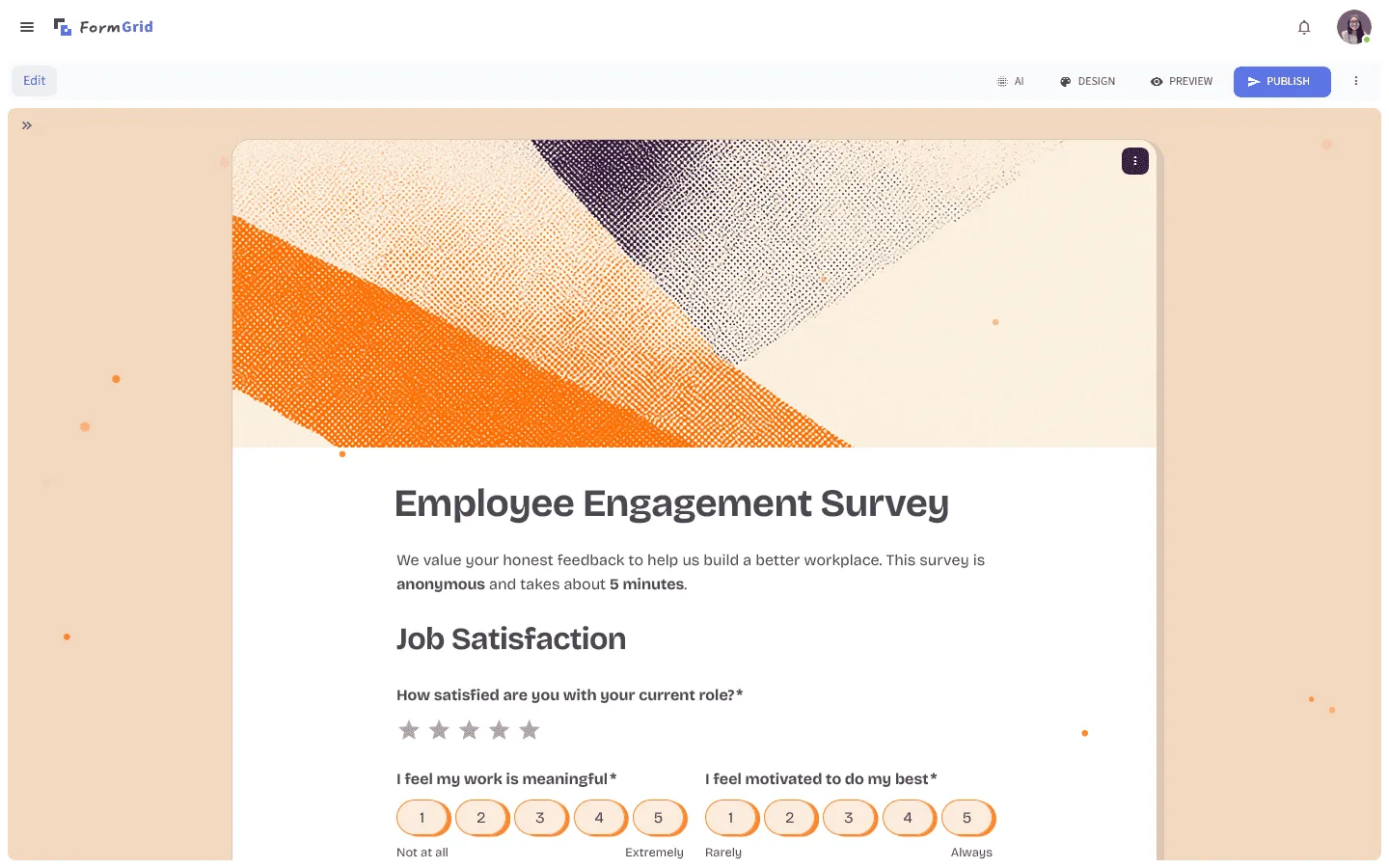
Below is an example of an employee engagement survey created with FormGrid. The survey groups questions into clear sections and uses a simple rating scale so employees can complete it quickly.
You can also create your own employee engagement survey using the same structure.
Employee engagement survey template
If you want to launch a survey quickly, using a ready-made employee engagement survey template can save time and ensure you cover the most important topics.
A typical template includes a mix of scaled questions and open feedback prompts. The goal is to measure overall engagement while also identifying the specific factors that influence employee motivation and retention.
You can also browse our free employee feedback survey template and staff satisfaction survey template as ready-to-use starting points.
Benefits of conducting an employee engagement survey
When organizations struggle with low productivity or high turnover, leadership often tries to solve the problem by guessing at the reasons. The primary benefit of an employee engagement survey is that it replaces executive assumptions with concrete, verifiable data.
Beyond simply giving employees a voice, a well-designed survey allows you to:
- Predict and prevent turnover: Identify teams suffering from poor management or a lack of psychological safety before those employees actively start looking for new jobs.
- Track the impact of organizational changes: Measure whether a recent shift in company strategy, a new remote work policy, or a change in leadership is actually resonating with the workforce.
- Surface hidden operational roadblocks: Provide an anonymous channel for employees to highlight broken internal processes or missing resources that are quietly destroying their daily productivity.
- Diagnose specific management issues: Isolate problems down to specific teams or departments. A company-wide average might look healthy, but sub-team data can reveal a specific manager who needs immediate coaching.
Types of employee engagement surveys
There is no single approach to surveying a team. Depending on your organization’s size and current needs, you will likely use a mix of survey formats to gather both high-level trends and immediate feedback.
The annual engagement survey
This is the overarching health check for the company. It usually contains 30 to 50 questions across a wide variety of themes, from leadership communication to career growth. It offers broad insight and sets the baseline metrics for the year.
Employee engagement pulse survey
Short, frequent check-ins (usually 5 to 10 questions) sent out monthly or quarterly. Pulse surveys maintain a steady read on organizational sentiment and let you track how specific metrics change between annual surveys.
Lifecycle surveys
These are triggered by specific milestones in an individual employee’s journey. Examples include 30-day onboarding check-ins, work anniversary surveys, or exit interviews when an employee leaves the company.
Subject-specific surveys
Deep dives into a particular topic or recent change. For example, a survey evaluating a recent transition to a hybrid work model, or a specific inquiry into compensation and benefits.
28 employee engagement survey questions to ask
The quality of an employee engagement survey depends heavily on the questions you ask. Good questions focus on the daily experience of employees and measure factors that influence motivation, trust, and long-term retention.
Most engagement surveys combine scaled questions (for example, a 1-5 agreement scale) with a few open-ended prompts that allow employees to share context in their own words.
Below are example questions grouped by key engagement themes.
Core engagement and connection
These questions measure how invested employees feel in the company’s future and help you calculate your overall employee advocacy.
- I am proud to work for this company.
- I would recommend this company to a friend as a good place to work.
- I see myself working at this company one year from now.
- I find the work I do for this organization to be meaningful.
- I feel aligned with the company’s broader mission and values.
Leadership and vision
Engagement starts at the top. When employees trust the people guiding the company’s direction, they are far more likely to remain committed through difficult periods.
- I trust the business decisions made by the senior leadership team.
- The leadership team communicates openly and honestly about the company’s direction.
- Our company leaders consistently keep employees informed about what is happening within the organization.
- Leadership is visibly invested in and contributing to our internal culture initiatives.
Professional growth and career progression
If career growth feels out of reach, engagement and retention will naturally dip. Employees need to see a future for themselves within the organization.
- I clearly understand the career paths available to me at this company.
- I am satisfied with the professional development and training opportunities provided to me.
- I feel that my current role makes good use of my specific skills and abilities.
- I believe there are fair and equal opportunities for career growth for all employees here.
Teamwork and collaboration
The people an employee works with every day heavily influence their overall experience. Open communication and collaboration help solve problems faster and make work more enjoyable.
- I feel that my direct team works well together.
- I feel comfortable sharing my honest opinions and ideas with my team members.
- Communication within my team is consistently effective and transparent.
- Team members are willing to help each other when needed.
Management effectiveness and support
The relationship an employee has with their direct manager is one of the strongest predictors of retention. These questions evaluate that specific dynamic.
- My manager communicates project expectations clearly.
- My manager gives me actionable, helpful feedback on a regular basis.
- My manager cares about my well-being as a person, not just as a productive employee.
- I frequently receive recognition from my manager when I execute good work.
Work environment and psychological safety
These questions evaluate the daily conditions of the job and whether the employee feels safe and supported in their environment.
- I am able to maintain a healthy balance between my work duties and my personal life.
- I have the necessary resources, tools, and equipment to do my job well.
- I feel safe taking risks and making mistakes in my current team without fear of unfair punishment.
- The company fosters an inclusive environment where I feel a strong sense of belonging.
Open-ended questions
Include a few of these to gather deep context:
- What three words would you use to describe your everyday experience at this company?
- If you were the CEO for a day, what is the single biggest thing you would change about our organization?
- What is the greatest obstacle to your daily productivity right now?
Employee engagement survey questions to avoid
Knowing what you should avoid asking is just as important as knowing what to ask. If you are reviewing an employee engagement survey example online, watch out for these poorly phrased questions, which result in flawed data and lower your overall response rate:
The leading question
Example: “How much do you enjoy our new, generous remote work policy?”
This phrasing forces a positive response and skews your data. Keep questions entirely neutral.
The double-barreled question
Example: “Do you feel your manager is approachable and knowledgeable?”
What if the manager is approachable, but lacks technical knowledge? The employee cannot accurately answer this using a single scale. Split it into two separate questions.
The overly demanding question
Example: “Please describe your full experience of working with the company over the last twelve months.”
This prompt is too broad. Employees do not want to recount an entire year in an essay format. Keep open-ended prompts focused and specific.
The intrusive question
Example: “Does traveling for work cause friction in your personal relationships?”
This crosses the line into personal matters. Keep the focus strictly on the workplace experience and professional well-being.
The “snitch” question
Example: “Does your manager appear to favor some employees over others? If yes, who?”
Employees will be hesitant to answer this and unwilling to name their colleagues. This type of question destroys the psychological safety required for an anonymous survey.
How to conduct an employee engagement survey
If you are researching how to conduct employee engagement survey cycles effectively, remember that a successful survey requires more than just picking a template and sending an email. From knowing how to create an employee engagement survey to analyzing the final data, here is the complete lifecycle.
Step 1: Secure buy-in and communicate the “why”
If you are wondering how to increase employee engagement survey participation, it starts with securing employee buy-in. If you simply drop a link in a company Slack channel with no context, expect low participation.
Before launching the survey, send an announcement that provides a detailed overview of its purpose. Explain exactly how the data will be used to shape workplace improvements and give employees a timeline of when they can expect to see the summarized results. Proactive communication ensures that employees understand that their time and honest feedback will actually drive change.
Step 2: Choose your employee engagement survey software
The tool you use to run the survey can influence both completion rates and data quality. If the survey is difficult to navigate or looks overly complex, employees are more likely to abandon it halfway through.
Look for a platform that makes surveys easy to complete on both desktop and mobile devices and allows you to organize questions into clear sections. If you are unsure where to start, you can use FormGrid’s survey generation tool. You provide a short prompt (e.g., “Create a 15-question pulse survey focusing on remote work communication”), and it generates the structure, questions, and a visual theme.
If you are currently evaluating options, you can explore our complete guide on the best employee engagement survey tools on the market.
Step 3: Guarantee anonymity and privacy
Honest feedback depends heavily on trust. Employees need to feel safe sharing their opinions, especially if that feedback is critical of their direct management. If they worry their answers can be traced back to them, they will either opt out of participating or only provide safe, positive responses.
Communicate clearly that the survey is anonymous, and ensure your survey platform aggregates the data rather than tying responses to individual email addresses. If you have very small departments (e.g., fewer than four people), be careful about segmenting the data so narrowly that it accidentally identifies individuals.
Step 4: Distribute the survey effectively
Make sure your survey is easy to open and complete on any device. Give people dedicated time to fill it out, encourage managers to allocate 15 minutes during the regular workday for their teams to take the survey. Making it part of regular working hours signals that their input is valued as real work, not an after-hours chore.
Send the survey through the communication channels your team actively uses (email, Teams, Slack) and follow up with one or two brief reminders before the survey window closes.
Step 5: Analyze the results
Collecting responses is only the first step. The real value of an employee engagement survey comes from analyzing the data and turning the findings into clear actions.
Check the response rate
Start by reviewing the overall participation level. Engagement surveys are most reliable when a large share of employees take part. Many organizations aim for a response rate of 70% or higher.
A low response rate can indicate survey fatigue, lack of trust in anonymity, or uncertainty about whether the results will lead to real change.
Measure favorability scores
Instead of focusing only on average scores, many organizations use favorability as their main metric.
Favorability measures the percentage of employees who selected positive responses such as “Agree” or “Strongly agree”.
For example:
| Question | Favorability |
|---|---|
| I feel proud to work for this company | 84% |
| Leadership communicates clearly | 62% |
| I see career growth opportunities | 48% |
In this example, the career growth score signals a clear improvement opportunity.
Compare results across teams
Company-wide averages can hide important patterns. Segment the results by department, team, tenure, and location to identify whether engagement challenges are company-wide or limited to specific teams or management structures.
For example, if one department scores significantly lower on leadership communication, it may indicate a local management issue rather than an organization-wide problem.
Review open-ended feedback
Quantitative scores show where problems exist, but open-ended responses explain why.
Carefully read the written comments and look for recurring themes. Employees often highlight issues such as unclear priorities, missing tools, or communication gaps that are not obvious from the numerical data alone.
Identify priority areas
Once patterns emerge, select two or three key areas that require attention. Trying to fix everything at once usually leads to scattered efforts and limited progress.
Focus on issues that meet three criteria:
- low favorability scores
- repeated mentions in comments
- strong impact on daily work
Turn insights into action
Survey results should lead to concrete improvements. Create a short action plan that includes:
- the issue identified in the survey
- the specific change being implemented
- the leader responsible for the initiative
- a timeline for reviewing progress
Communicating these steps to employees helps reinforce trust in the survey process.
Track progress over time
Employee engagement surveys are most useful when repeated regularly. After implementing improvements, run a pulse survey several months later to measure whether scores have improved. You can use our employee pulse survey template as a starting point.
Tracking trends over time allows organizations to see whether changes are working and where further adjustments are needed.
Step 6: Communicate the results
Knowing how to communicate employee engagement survey results is critical. Gathering feedback and going silent damages trust immediately. Synthesize the survey results within a few weeks of it closing and share those results transparently.
Present your high-level findings in an all-hands meeting or via a detailed written report. Be transparent about what the company is doing well, and more importantly, acknowledge the areas where the organization scored poorly. Acknowledging negative feedback builds credibility.
The survey highlights the problems, but it rarely provides the exact solutions. Feedback is only valuable when it leads to action. Here is a standard 30-day timeline for turning results into progress:
- Week 1: Share the topline results with the company and thank employees for their honesty. Pick one to three specific priority areas for focus and assign clear executive owners to each.
- Week 2: Have managers gather their direct teams for discussion sessions. Use this time to collect fresh ideas for quick wins and long-term solutions to the problems identified in the survey.
- Week 3: Draft a concrete action plan, complete with success metrics, owners, and clear deadlines for implementation.
- Week 4: Communicate the new action plan widely across the company. Set dates for your next pulse check to follow up on progress. This establishes a continuous cycle of trust and accountability.
Employee engagement survey benchmark data
Understanding your own survey results requires context. Comparing your organization’s scores against industry averages and global trends helps you determine whether your engagement levels are healthy or require immediate intervention.
According to latest workplace research by Gallup and other industry leaders, here are the key benchmarks:
- Global average: Approximately 21% of employees were considered “engaged” at work in 2024. This means nearly 8 out of 10 employees are either doing the bare minimum or are actively working against their organization’s interests.
- United States average: The U.S. typically sees higher engagement than the global average, hovering around 31% in 2024.
- High-performance benchmark: Organizations recognized as “best places to work” or recipients of engagement awards typically see engagement rates of 70%. This is the gold standard for healthy organizational culture.
Employee engagement survey best practices
A successful feedback program requires more than just asking the right questions. Adhering to these employee engagement survey best practices ensures your data is accurate and your employees feel their time is being respected.
Guarantee total anonymity
Trust is the most important factor in a survey. Employees must feel 100% certain that their responses cannot be traced back to them personally. If they fear repercussions for honest feedback, they will either give safe answers or stop participating entirely.
Commit to a clear action plan
Only ask questions about things you are actually willing and able to change. If you ask for feedback on your office environment and then do nothing with that data, it can actually lower engagement by making employees feel ignored.
Choose the right frequency
Don’t cause “survey fatigue” by asking too many questions too often. A common rhythm is one comprehensive annual survey mixed with shorter, quarterly pulse checks to track specific initiatives.
Communicate the ‘Why’ before the ‘How’
Before you send out the link, hold a team meeting or send an email explaining why you are running the survey, who will see the results, and exactly how the data will be used to make improvements.
Keep it concise
Respect your employees’ time. An annual survey should take no more than 15-20 minutes to complete, and a pulse survey should be finishable in under 5 minutes.
Benchmark your results
While internal trends are important, it helps to see how your scores compare to industry benchmarks for companies of a similar size and sector. This gives you external context for what a “good” score actually looks like.
Common survey mistakes to avoid
Even well-intentioned engagement surveys can fail if they trip over a few classic obstacles. Keep your strategy effective by avoiding these frequent missteps:
- Asking but not acting: This is the fastest way to destroy trust in the survey process. If you continuously ask for feedback and never implement any changes, employees will stop taking the survey seriously and your response rates will plummet.
- Surveying too often (or not enough): If you run a 50-question survey every month, you will cause survey fatigue. If you only ask once every two years, you lack the data to make current decisions. Find a cadence that works for your organization, such as one comprehensive annual survey mixed with quarterly, targeted pulse checks.
- Ignoring the open-text comments: While the numerical data is easier to chart and present, the written comments contain the context you need to actually understand the numbers. Skipping the comments means missing the story.
Conclusion
An employee engagement survey is one of the most effective ways to understand how employees actually experience their work environment.
When designed well, these surveys reveal issues that might otherwise remain hidden. The most successful organizations treat engagement surveys as part of a continuous feedback cycle: ask for input, analyze the results carefully, and implement visible improvements.
By running engagement surveys regularly and acting on employee feedback, organizations can strengthen culture, improve retention, and build more motivated teams.
Employee engagement survey FAQs
How many questions should an employee engagement survey have?
Most employee engagement surveys include between 15 and 40 questions. Pulse surveys typically include 5-10 questions.
What questions should be included in an employee engagement survey?
Most engagement surveys cover several core themes:
- connection to company mission
- trust in leadership
- career growth opportunities
- team collaboration
- manager support
- work environment and psychological safety
A balanced survey usually combines scaled questions with a few open-ended prompts to capture deeper feedback.
What is the purpose of an employee engagement survey?
The purpose of an employee engagement survey is to measure how motivated and connected employees feel toward their organization. The results help companies identify cultural issues, improve leadership practices, and increase retention.
What is the difference between an engagement survey and a pulse survey?
An engagement survey is usually a comprehensive questionnaire run once per year. A pulse survey is a shorter survey sent more frequently (often monthly or quarterly) to track changes in employee sentiment over time.
How often should you run an employee engagement survey?
Most organizations run a full survey once per year and shorter pulse surveys quarterly.
Should employee engagement surveys be anonymous?
Yes. To get honest feedback, surveys should be anonymous and responses should be aggregated.
What is a good response rate for an employee engagement survey?
A response rate above 70% is generally considered strong.