50+ Post-Event Survey Questions (with Examples & Template)
Events are expensive. Whether it is a virtual webinar, a high-stakes company retreat, or a large industry conference, you pour time, money, and energy into making it happen. But once the lights go down and the guests leave, how do you know if it was actually a success?
You can’t just guess. You need data.
The only way to get that data is to ask the right people the right questions at the right time. A well-timed post-event survey is the difference between assuming your event was “fine” and knowing exactly what to do better next year.
This guide will cover why you need to ask these questions, how to structure your survey for maximum engagement, and exactly what to ask to get actionable insights.
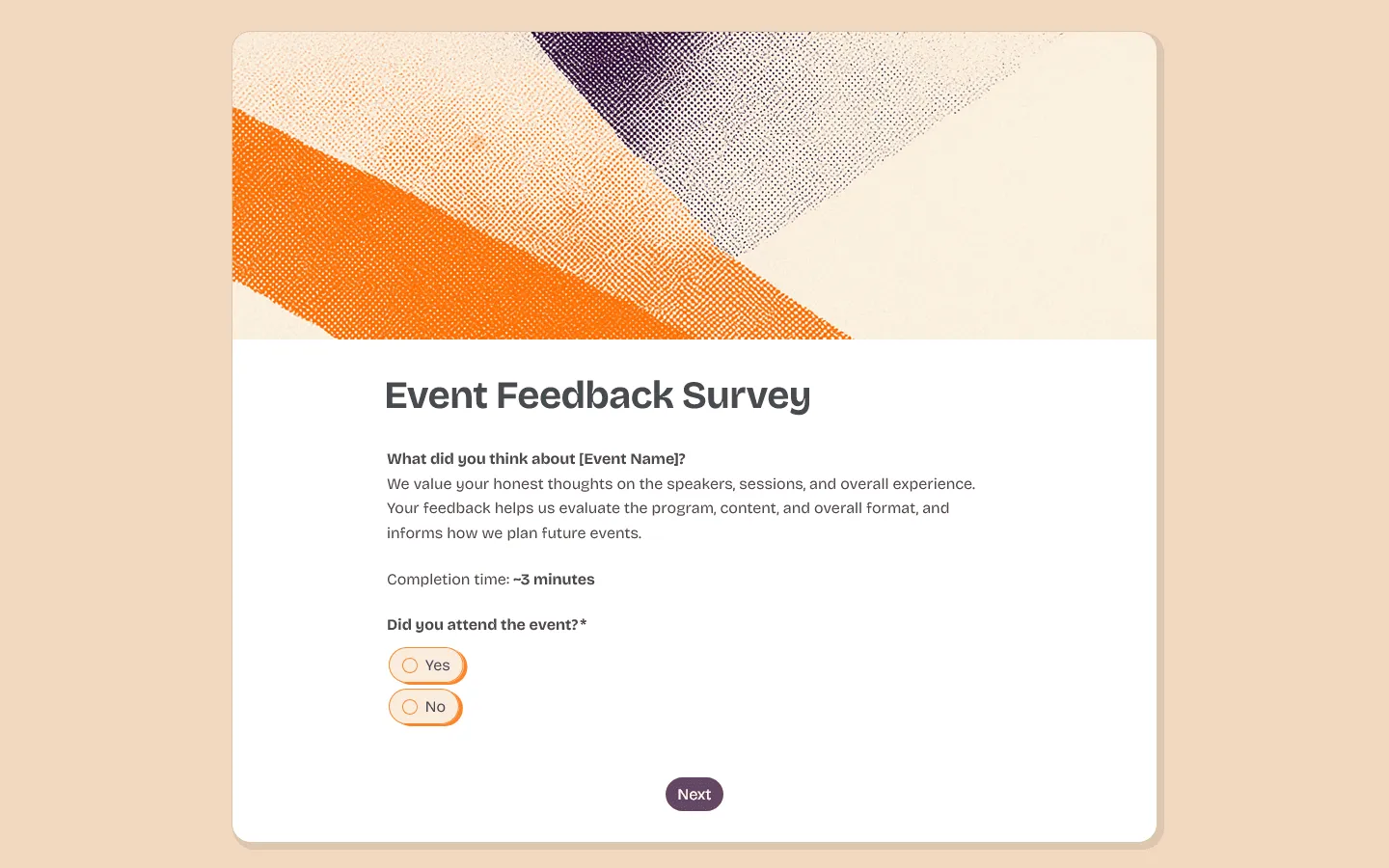
Why you need a post-event survey
You might feel like you know how the event went. You saw people smiling, the food ran out, and no one complained to your face. But that is anecdotal evidence, and it is dangerous to rely on it. To justify the budget for the next event and truly improve, you need concrete feedback.
Running a post-event survey allows you to accomplish several important goals.
Measure event success
Every event starts with a goal. Maybe you wanted to generate 50 qualified leads, or perhaps you wanted to increase brand awareness among a specific demographic. A survey allows you to ask direct questions that map back to these KPIs. Did they learn what you wanted them to learn? Did they meet the people you wanted them to meet?
Improve future planning
Maybe the venue looked great on Instagram, but the acoustics made it impossible to hear the keynote. Maybe the sessions were knowledgeable, but the Q&A was cut too short. Attendees see things you miss. Detailed feedback can reveal what worked, what didn’t, and what should change. Those insights can shape decisions about the agenda, venue, staffing, vendors, and the timeline for planning the next event.
Show attendees you care
Asking for feedback sends a strong signal that you value your attendees’ opinions. It changes the dynamic from a one-way broadcast to a two-way conversation. When people feel heard, they are more invested in the community you are building and more likely to return.
How to conduct a post-event survey effectively
Sending a survey is easy; getting people to answer it is hard. To ensure you get useful data rather than silence, you need a strategy.
Step 1: Pre-event preparation
Don’t wait until the event is over to draft your questions. You should know your “success metrics” before the doors even open. If your goal is “networking,” you need to design questions that measure the quality of connections made, not just the quantity.
Step 2: Timing is everything
The “event glow” fades faster than you think. Send your survey within 24 to 48 hours of the event conclusion. Studies on human memory consistently show that recall accuracy drops quickly over time, so send your survey while the experience is still fresh.
- 0-24 hours: Participants are still thinking about the event. Feedback will be specific and emotional.
- 48+ hours: Details blur. You will get generic answers like “It was good.”
- 1 week later: You have likely lost them entirely.
Step 3: Use the right incentives
Your attendees are busy professionals. Sometimes a small nudge helps grease the wheels.
- Internal events: Acknowledgment or a “thank you” from leadership often suffices.
- External conferences: Consider entering respondents into a raffle for a relevant prize (e.g., a ticket to next year’s event, a tech gadget, or a gift card). Avoid generic swag; offer something they actually value.
Step 4: Close the loop
This is the step most organizers miss. If you run an annual event, share what you changed based on last year’s feedback. Send an email saying, “You asked for more networking time, so we added two coffee breaks this year.” When people see that their input leads to real action, their response rates will skyrocket.
Best practices for high response rates
You are competing for attention. Here is how to respect your attendees’ time while getting the answers you need.
- Keep it under 5 minutes: Be ruthless with your editing. If a question doesn’t provide data you can act on, delete it. If the survey looks like a homework assignment, people will close the tab. Usability research consistently shows that shorter surveys lead to higher completion rates.
- Use mobile-first design: Most effective post-event surveys are taken on a phone (in a taxi, at the airport, waiting for a flight, or on the commute home). Test your survey on a mobile screen first. If they have to pinch-and-zoom, you’ve lost them.
- Personalize the invitation: “Dear Attendee” gets deleted. “Hi John” gets opened. Use your email marketing tool to personalize the subject line and the greeting. It creates a sense of connection.
50+ post-event survey questions (with examples)
Not all post-event feedback survey questions are useful. Good post-event survey questions are clear, specific, and tied to decisions you can actually make. If a question does not influence next year’s agenda, budget, or logistics, it does not belong in the survey.
Question examples by audience
Different groups experience the same event very differently. Using the same post-event survey questions for everyone leads to weak data. Below are focused post-event survey question examples by role.
Post-event survey questions for attendees
These are the core questions to ask on a post-event survey. They measure value, experience, and likelihood to return. The goal here is to understand the “customer journey” from their perspective.
- Overall, how satisfied were you with the event?
- Did the event meet the goals you had when registering?
- What part of the event was most valuable to you?
- What would you change or improve next time?
- Would you attend this event again?
The “goals” question is critical. Attendees might have loved the food but hated the content. If their goal was to learn, you failed. If their goal was to eat free lunch, you succeeded. You need to know which game you are playing.
Post-event survey questions for speakers
Speakers see content quality, timing, and audience engagement up close. They are also your VIPs, if they have a bad experience, they tell other industry experts.
- Was communication before the event clear and timely?
- Did you have enough support during your session?
- How engaged was the audience?
- Would you be interested in speaking again?
- What could organizers improve for future speakers?
Pay attention to the “support” question. Technical glitches or lack of water on stage are small annoyances that stop top-tier speakers from returning.
Post-event survey questions for staff and employees
Internal feedback reveals operational gaps that attendees never see. Your staff knows intimately where the bottlenecks were.
- Were your responsibilities clearly defined?
- Did staffing levels feel adequate?
- What caused the most friction during the event?
- What should be done differently next time?
Look for mentions of “burnout” or “confusion.” If staff didn’t know their roles, that stress bleeds into the attendee experience.
Post-event survey questions for volunteers
Volunteers are often the first to notice logistical breakdowns because they are the ones dealing with confused attendees on the ground.
- Did you receive enough training and information?
- Were shifts and roles clearly communicated?
- Did you feel supported during the event?
- Would you volunteer again?
Volunteers are free labor, but they aren’t infinite. If they feel unsupported or thrown into the deep end without training, they won’t come back next year.
Post-event survey questions for organizers
This is your internal postmortem. This doesn’t necessarily need to be a formal survey, but these questions should guide your debrief meeting.
- What worked better than expected?
- What caused delays or stress?
- Were budget assumptions realistic?
- What would you simplify next time?
Post-event survey questions for vendors and exhibitors
Exhibitors care about exposure, traffic, and logistics. They are paying for access to your audience. If they don’t get it, they churn.
- Was booth setup and teardown smooth?
- Did you get meaningful attendee traffic?
- Was the audience relevant to your business?
- Would you exhibit again?
“Meaningful traffic” is carefully phrased. 1,000 attendees walking past a booth is useless if none of them stop. You want to know if they got leads, not just foot traffic.
Post-event survey questions for sponsors
Sponsors evaluate ROI more strictly than attendees. They need hard numbers and visibility.
- Did the event meet your sponsorship goals?
- Was your brand visibility as expected?
- How would you rate communication with the organizers?
- Would you sponsor future events?
If a sponsor says “No” to future events, call them immediately. A survey comment is a flag; a phone call is the salvage operation.
Question examples by topic
The key to a good survey is flow. Start broad, zoom in on specifics, and end with open opportunities for feedback. Below are the most critical categories to cover.
General satisfaction
These questions are your high-level dashboard. They tell you the overall health of your event brand and are crucial for benchmarking year-over-year performance. If you only ask one question, make it the Net Promoter Score (NPS).
- On a scale of 1-10, how likely are you to recommend this event to a friend or colleague? (NPS)
- Overall, how would you rate the event? (1-5 Stars)
- Did the event meet your expectations?
- How would you rate the value you received for the ticket price?
- Will you join us again next year?
The “Value” question is particularly important for paid events. If satisfaction is high but value perception is low, your pricing strategy might simply be too aggressive, or you didn’t clearly communicate the ROI before the event.
Content & speakers
Content is usually the primary driver for attendance. You need granular data here to understand which topics resonated and which fell flat. This section helps you curate the agenda for next year.
- Which session was your favorite and why?
- Which session was your least favorite?
- How would you rate the quality of the speakers overall?
- Did the content match the session descriptions?
- Was the session length too long, too short, or just right?
If you have a multi-track event, use conditional logic in your form builder. Only show questions about specific sessions if the attendee selects that they attended them. Asking someone to rate a speaker they didn’t see is the fastest way to ruin your data.
Venue & logistics
Maslow’s hierarchy of needs applies to events, too. If attendees are hungry, cold, or offline, they cannot appreciate your content. “Hygiene factors” like Wi-Fi and food rarely get praise when they are good, but they generate a lot of complaints when they are bad.
- How would you rate the venue location and accessibility?
- How was the food and beverage quality?
- How would you rate the audio/visual quality?
- Did you have enough time for breaks?
- Was the event easy to navigate (signage, app, maps)?
Look for patterns in the “accessibility” and “navigation” feedback. Often, event organizers know the venue so well they forget that first-time visitors have no idea where the restrooms are.
Networking opportunities
For many professionals, the “Hallway Track” (the casual conversations between sessions) is more valuable than the main stage. If your goal was community building, you need to measure the quality of these interactions.
- Did you have sufficient opportunities to network?
- How would you rate the quality of the connections you made?
- Did you use the event app to connect with other attendees?
- Would you have liked more structured networking time (e.g., speed networking, roundtables)?
A “No” on sufficient opportunities is an easy fix for next year: add longer coffee breaks or dedicated happy hours.
Virtual & hybrid experience
If your event had a remote component, the technology is the venue. User experience (UX) friction is the number one killer of virtual event engagement.
- How easy was it to access and navigate the virtual platform?
- How was the audio and video quality of the stream?
- Did you feel included in the live event experience?
- Which features of the virtual platform did you find most useful?
Questions for virtual and online events
Virtual and hybrid events need different questions. Platform experience matters as much as content.
- How easy was it to access the event platform?
- Did you experience technical issues?
- Did you feel engaged throughout the event?
- How did the virtual format compare to in-person events?
Additional open-ended questions
Rating scales give you “what,” but text boxes give you “why.” While they are harder to analyze at scale, they often contain the most valuable insights. Always include these three distinct angles.
-
“What was your biggest takeaway from this event?” This tests your content effectiveness. If you wanted the event to be about “Innovation,” but everyone writes that their biggest takeaway was “The lunch was great,” you have a messaging problem.
-
“What is the one thing you would change about this event?” The phrasing “one thing” is psychological magic. If you ask “What would you improve?”, people might list 10 minor grievances. Asking for “one thing” forces them to prioritize the friction point that actually mattered most to them.
-
“Do you have any other suggestions or comments?” The catch-all. This is where you find specific shout-outs for helpful staff members, detailed bug reports for your app, or wild ideas for next year that you never would have brainstormed yourself.
Post-event survey template
We have put together a ready-to-use post-event survey template based on the questions and structures covered in this guide. It is designed to be short, mobile-friendly, and practical, without unnecessary questions.
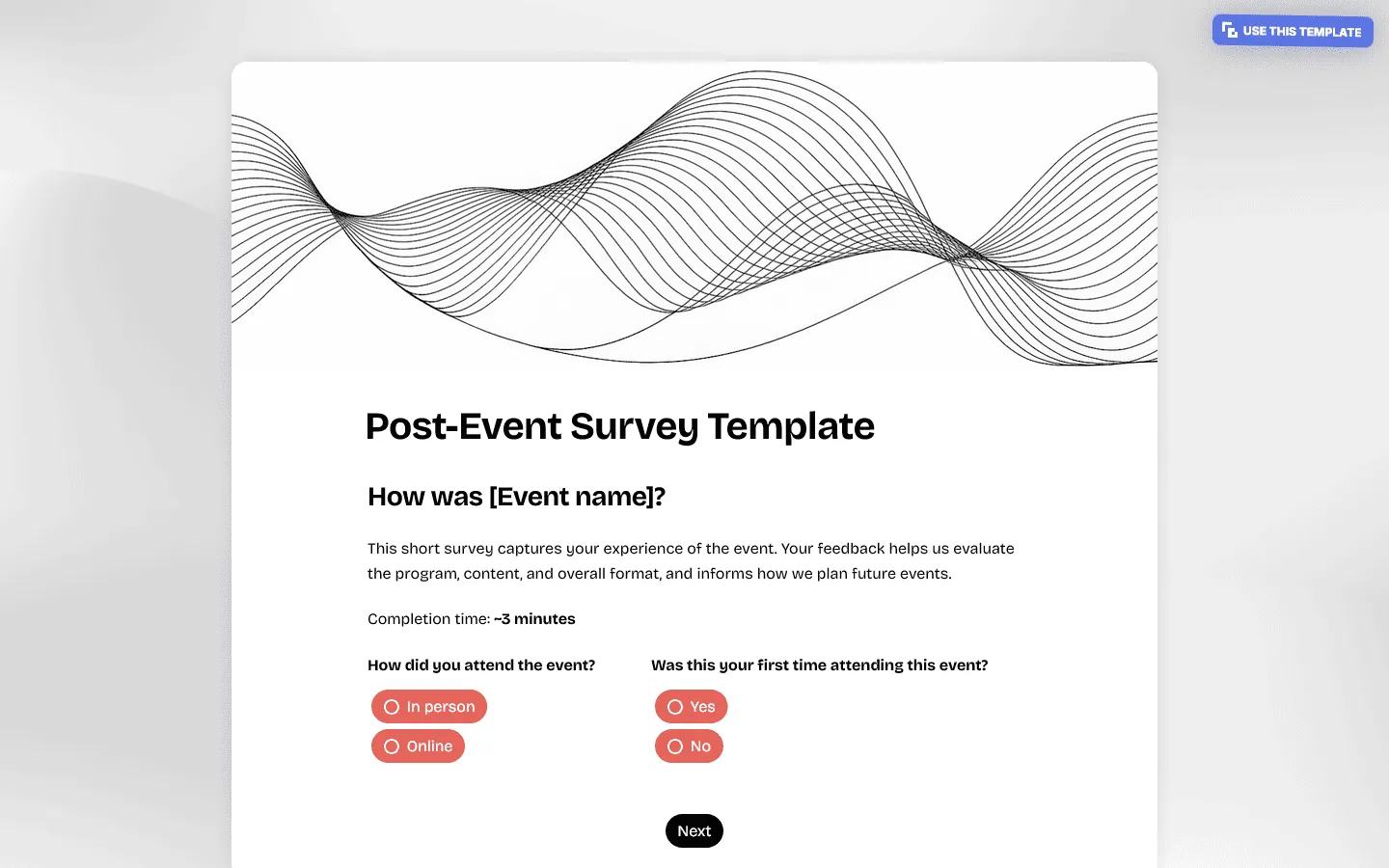 If your event is more specific, FormGrid can also create a custom post-event survey template for you. You simply describe the event in a sentence or two, for example the event type, audience, and what you want to learn. The form is generated instantly and can be adjusted before sending.
You can also browse our ready-to-use event feedback survey template and event satisfaction survey template as structured starting points.
Creating your post-event survey with FormGrid
You spend months planning your event branding. Do not send your attendees to a generic, boring survey form.
FormGrid allows you to build beautiful, branded post-event surveys that look like they belong to your company. You can add your logo, use your brand colors, and create a smooth experience that works well on mobile phones.
Plus, with FormGrid’s robust free plan, you can collect unlimited responses. You won’t be punished for having a successful event by hitting a paywall just because you got more feedback than expected.
Simply describe your event, brand or preferred design, target audience, and goals, and let FormGrid generate a post-event survey that is tailored to your needs in seconds.
Resources for event planners
Planning and evaluating an event is a multi-step process. These templates and guides can help before and after the event:
- Event registration form template: Collect attendee details, ticket choices, session preferences, dietary needs, accessibility requests, and consent before the event.
- Event feedback survey template: Collect comments, ratings, and improvement ideas after the event.
- Event satisfaction survey template: Measure attendee satisfaction with NPS, rating scales, and open questions.
- Satisfaction survey templates: Browse CSAT and NPS survey templates for different use cases.
FAQ
When is the best time to send a post-event survey?
Send it as soon as possible, ideally within 24 to 48 hours after the event concludes. The experience is fresh in attendees’ minds, leading to more detailed and accurate feedback. If you wait longer, response rates drop primarily because people simply move on to their next task.
How many questions should be in a post-event survey?
Keep it between 5 and 10 questions. If it takes longer than 3-5 minutes to complete, completion rates drop significantly. Stick to the essentials: 2-3 rating questions, 2 open-ended questions, and 1-2 demographic or logistic questions.
Should post-event surveys be anonymous?
Generally, yes. Anonymity encourages honest feedback, especially for negative comments. People are often polite and won’t tell you the food was bad if their name is attached. However, you can include an optional field for their name or email if they want a follow-up on a specific issue.
What is a good response rate for a post-event survey?
Response rates vary by industry and event type.
- Internal events: Aim for 40-50%.
- Paid conferences/workshops: Aim for 30-40%.
- Free webinars: Expect lower, around 10-20%. To boost these numbers, mention the survey during the event closing remarks.
How to encourage participation?
Keep the email subject line punchy (e.g., “Quick question about [Event Name]”), promise (and deliver) a short survey, and offer a small incentive like a discount on next year’s ticket or entry into a prize draw.